Cart
0
🎉 Congratulations! You unlocked Complimentary Gift.

Solitaire round cut diamond stud earrings
$0
$ 0


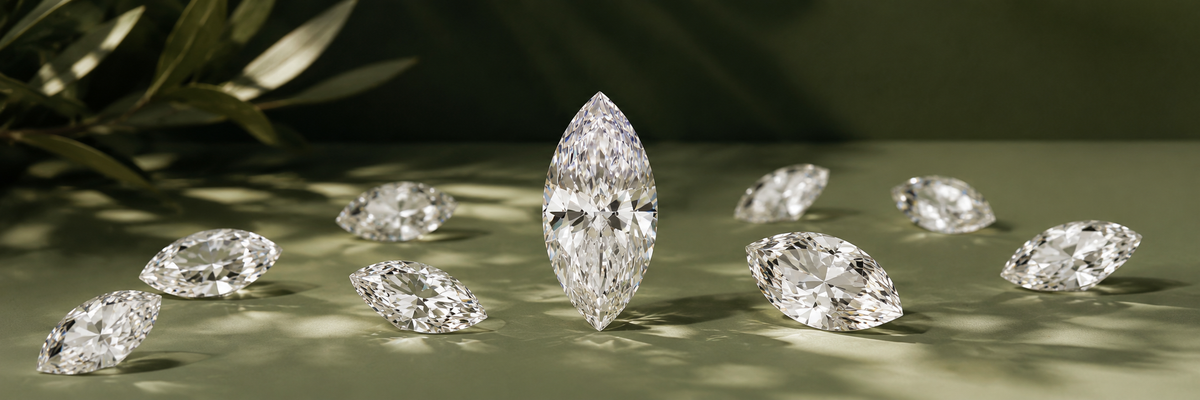
Most engagement rings use the same few shapes. Round, cushion, and princess show up again and again. But sometimes, one shape stands out from the rest. It has a long body and a sharp point on each end. That shape is the marquise diamond, and it tends to stick in your memory.
First, notice how it changes as you turn it. A round diamond looks round from any angle. However, a marquise diamond behaves differently. Straight on, it looks long and slim. From the side, the points look thin and delicate. This contrast is part of why people love it so much.
There is also a practical reason people choose this shape. Since it stretches out instead of staying round, a marquise diamond covers more of the finger. In fact, a one-carat marquise can look like a much larger round diamond once it sits on a hand. So if you want a bigger look on a smaller budget, this shape delivers.
This guide covers everything you need before buying one. First, we explain where the shape came from. Then, we break down its parts, its grading, and its proportions. We also cover the light and shadow pattern found in almost every marquise diamond. Finally, we walk through settings, since the pointed tips need extra protection.
By the end, you will feel ready to shop with confidence. Whether you visit a local store or browse a site like Lumera Fine Jewellery, you will know what questions to ask. After all, buying a diamond is a big decision, so it helps to understand exactly what you are paying for.

A marquise diamond has two pointed ends and a long, narrow body. The middle curves out slightly before tapering back to a point on each side. It is not the same as an oval shape. An oval has smooth, rounded ends, while a marquise ends in a sharp point, similar to a lemon or a small canoe.
This shape uses what jewelers call the brilliant cut style. In other words, the facets are shaped like triangles and kites instead of long rectangles. As a result, light bounces back up through the top of the stone instead of leaking out the sides. This is the same idea used in round diamonds, just stretched into a longer form.
Because the shape spreads out instead of staying compact, it covers more visual space on the finger. Therefore, a one-carat marquise diamond usually looks bigger than a one-carat round or cushion stone. This is one of the main reasons buyers choose this shape in the first place.
You might also hear this shape called a navette, which means "little boat" in French. Once you notice the resemblance, it is hard to unsee. The curved sides and pointed ends really do look like a small boat viewed from above. Some older jewelry catalogs still use this term instead of marquise.
The name navette never fully disappeared in Europe. For instance, an older jeweler in France or Belgium might still use it today. In the United States, however, most people say marquise or marquise cut instead. Still, if you come across the word navette while browsing an estate sale or a European site, remember it means the exact same shape.

The most common story traces this shape back to 18th century France. During that time, King Louis XV reportedly wanted a diamond cut to match his mistress's smile. Her name was the Marquise de Pompadour, and his jewelers created something new just for her. The result was a long, pointed shape unlike anything cut before, and her title stuck to it ever since.
Nobody knows exactly how true that story is today. Even so, one thing is certain: the shape survived and became popular. Back then, cutters shaped diamonds entirely by hand, without any machines to help. Because of that, creating two matching points took serious skill and patience.
As technology improved over the following centuries, the shape only got better. Today, machines control facet angles down to a fraction of a degree. Consequently, modern marquise diamonds look far more even and far more reflective than older versions. While the outline has stayed mostly the same, the precision behind it has come a long way.

A few things set this shape apart from other engagement ring stones. Each trait plays a role in how the diamond looks and wears over time.
Long body with pointed ends. This is the trait people notice first. No other common diamond shape has two sharp points facing each other. Even the pear shape only has one point.
Brilliant facet pattern. Like a round diamond, a marquise uses triangle and kite-shaped facets. As a result, it catches and bounces back light well. Step-cut shapes, like the emerald cut, work differently and give off a calmer flash.
Length-to-width ratio. This single number shapes the whole look of the stone. A higher ratio makes it thin and dramatic, while a lower ratio makes it look plumper, closer to an oval.
Symmetry. Because this shape has two points and two curves that must match, any unevenness stands out fast. In fact, a crooked marquise is easier to spot than a crooked round diamond.

Before comparing certificates or asking a jeweler questions, it helps to know the parts of the stone.
Table: The flat top surface. This is usually the first thing you notice, and it controls how much light bounces straight back at you.
Crown: The section between the table and the girdle. It catches light from the sides and directs it upward.
Pavilion: Everything below the girdle. This part drives most of the brightness. If it is too shallow or too deep, light escapes instead of bouncing back.
Girdle: The narrow band around the widest part of the stone. Prongs typically grip the stone here.
Culet: A tiny point at the very bottom. On a marquise diamond, you barely notice it without a loupe.
Pointed tips: The two sharp ends that define this shape. These are the thinnest, most exposed areas, so they chip most easily. Every setting choice later in this guide comes back to protecting these two spots.
Since this shape is long instead of round, its measurements differ from a round stone at the same weight. Therefore, use the chart below as a general guide rather than an exact rule.
| Carat Weight | Approximate Dimensions (mm) |
|---|---|
| 0.50 ct | 7.0 x 3.5 |
| 0.75 ct | 8.0 x 4.0 |
| 1.00 ct | 9.0 x 4.5 |
| 1.50 ct | 10.5 x 5.3 |
| 2.00 ct | 11.8 x 5.9 |
| 2.50 ct | 12.5 x 6.3 |
| 3.00 ct | 13.2 x 6.6 |
If you shop online, always check the exact measurements on the certificate too. That way, you get a real sense of size instead of relying on carat weight alone.
Every diamond, no matter the shape, gets judged on four things: cut, color, clarity, and carat weight. These four factors apply to a marquise diamond just like they apply to a round one. However, a couple of them carry more weight here because of the pointed ends.

Cut: On a round diamond, cut grade mostly comes down to facet angles. On a marquise diamond, however, cut quality also depends on the outline. Do the two halves mirror each other? Are the points sharp and even? A grading report gives you numbers, but your own eyes matter too.
Color: Diamond color runs from D, meaning no color, down toward Z, where a yellow tint becomes obvious. Since a marquise diamond has narrow points where color tends to gather, buyers often choose one grade higher than they would for a round stone.
Clarity: Clarity refers to marks inside the stone, called inclusions, and marks on the surface, called blemishes. On a marquise diamond, an inclusion near a pointed tip stands out more than one buried in the center. So, ask your jeweler exactly where any inclusions sit before you buy.
Carat: Carat simply means weight, and it has nothing to do with shape. Still, because the long outline spreads that weight across more surface area, a smaller carat number can look much bigger once set.
Whatever combination you choose, always ask for a grading report from an independent lab like GIA or AGS. This report proves exactly what you are paying for, especially when shopping online.
Getting the proportions right matters more than almost any other decision here. After all, carat weight and clarity affect value, but proportion affects how much you enjoy looking at the stone daily. A marquise cut too short looks stubby. On the other hand, one cut too long looks thin and blade-like.
| Feature | Recommended Range |
|---|---|
| Length-to-Width Ratio | 1.75 to 2.15 |
| Table | 53% to 63% |
| Depth | 58% to 64% |
| Symmetry | Very Good to Excellent |
| Polish | Excellent |
Most buyers end up liking a ratio close to 2.00. At that point, the stone looks long and bold, yet still balanced. Drop below 1.75, and it starts to resemble a rounded oval instead. Push past 2.15, and the points get so sharp the stone looks almost like a blade. Meanwhile, table and depth percentages matter too, since both affect how much brightness escapes versus bounces back. A jeweler experienced with this shape can often predict the look just from the certificate.

If you research marquise diamonds, you will run into the term "bow-tie effect" often. This refers to a darker patch across the center of the stone. It sits right where the two halves meet, shaped a bit like an actual bow tie.
This shadow forms because of how light travels through a long, stretched shape. Round diamonds rarely show this problem, since light moves evenly around the circle. However, marquise, oval, pear, and heart shapes behave differently. Their length forces certain facets into angles that reflect light less efficiently. As a result, a shadow forms right in the middle.
Not every bow-tie looks the same. A well-cut stone shows only a faint shadow, barely visible unless you look for it. A poorly cut stone, however, can show a dark, obvious stripe. Therefore, always view a video of the actual stone under different lighting before buying. Photos alone can hide or exaggerate this effect.
A faint bow-tie is completely normal, so there is no need to worry about it. Instead, watch for a shadow that stays dark and wide no matter how you tilt the stone. That kind of shadow usually signals uneven cutting, so ask the seller about it directly.
Color grading runs from D, meaning no color, down toward Z, where a yellow or brown tint becomes obvious. For most buyers, a grade between G and I works well. At this range, the stone looks white to the eye, especially indoors. Going higher, toward D, E, or F, raises the price but rarely changes the visible result.
There is one extra detail worth knowing here. Since the pointed ends taper to almost nothing, any trace of color tends to show up right at those tips. Because of that, some buyers choose one grade higher just to keep the points looking clean.

Clarity grade measures marks inside the stone, called inclusions, and marks on the surface, called blemishes. A grade between VS1 and SI1 usually gives you an eye-clean stone, meaning nothing shows without magnification.
Still, location matters as much as grade here. Since the tips are thin and exposed, an inclusion near a point stands out more than one buried safely in the center. So, always ask your jeweler exactly where inclusions sit before buying.

The metal you choose affects both the look and the durability of the ring. In fact, it plays a direct role in protecting those pointed tips over time.
Platinum and white gold remain the most popular choices for marquise rings. Both metals resist daily wear well, and platinum especially holds prongs tightly around the tips. Still, many buyers prefer yellow or rose gold for a warmer look. If you choose one of these, ask your jeweler about reinforcing the prongs for extra protection.
The setting you choose does two jobs. First, it shapes how the ring looks overall. Second, it decides how well the pointed tips survive daily bumps.
Solitaire: A single marquise diamond on a plain band. This simple option lets the stone's outline stand out on its own.
Halo: Smaller diamonds circle the main stone, adding brightness and making it look bigger.
Hidden Halo: Small diamonds sit underneath the main stone, so the effect only shows from certain angles.
Pavé: Tiny diamonds line the band, adding shine without changing the ring's overall shape.
Bezel: A metal rim wraps fully around the stone. Therefore, this setting protects the tips better than any other option.
East-West: The stone sits sideways instead of pointing up, giving the ring a modern, different look.
Vintage: Detailed metalwork and small beaded edges, called milgrain, give the ring an older-style feel.
Three Stone: The marquise sits center stage, flanked by two smaller stones on either side.
Comparing shapes side by side makes the decision easier. Here is how marquise stacks up against the shapes people compare it to most.
| Feature | Marquise | Oval | Pear | Round |
|---|---|---|---|---|
| Shape | Long with pointed ends | Long and rounded | Teardrop | Round |
| Brightness | High | High | High | Highest |
| Looks Larger for Carat | Yes | Somewhat | Somewhat | No |
| Finger Coverage | High | High | Medium | Medium |
| Price per Carat | Lower than round | Moderate | Moderate | Highest |
Against a round diamond, marquise usually wins on price per carat. This happens because cutting a round shape wastes more of the rough stone. Against an oval, the difference comes down to personality. An oval looks calm and rounded, while a marquise brings sharper points and a bolder overall shape.
| Feature | Lab-Grown | Natural |
|---|---|---|
| Appearance | Same as natural | Same as lab-grown |
| Hardness | Same | Same |
| Price | Lower | Higher |
| Origin | Made in a lab | Formed underground over time |
| Certification | Available | Available |
A lab-grown diamond is not a shortcut or a lesser option. In fact, it shares the exact same carbon structure, hardness, and grading scale as a natural stone. The only real difference is origin, and that difference mostly affects price. Since lab-grown stones usually cost less, many buyers use the savings to size up. Either way, always request a grading report before buying.

Pros
Looks bigger than other shapes at the same carat weight
Makes the finger appear longer and slimmer
Usually costs less per carat than a round diamond
Stands out from the common round and cushion shapes
Cons
Shows some bow-tie effect in almost every stone
Needs a protective setting for the exposed tips
Reveals symmetry issues more easily than round diamonds
Harder to find in vintage or antique styles
A diamond is one of the hardest materials on earth. Still, it can chip, especially at the two thin points on a marquise diamond. Therefore, a little extra care goes a long way.
Cleaning: Soak the ring in warm water with mild dish soap for a few minutes. Then, brush gently with a soft brush before rinsing. Do this every couple of weeks, and avoid harsh chemicals.
Storage: Keep the ring in its own pouch instead of tossed in with other jewelry. Otherwise, the sharp tips can scratch softer metals or chip against other pieces.
Protecting the tips: Remove the ring before heavy lifting, gardening, or sports. A direct hit is the most common cause of a chipped tip.
Checkups: Visit a jeweler about every six months to check the prongs. Prongs loosen slowly over time, so catching this early saves money later.
Before you buy, run through this short checklist:
Confirm the diamond has a grading report from a trusted lab.
Check the length-to-width ratio to match the look you want.
Look at the stone in person or on video to check for a bow-tie shadow.
Ask if any inclusions sit near the pointed tips.
Pick a setting, like bezel or prong with reinforced tips, that will protect the points over time.
Compare lab-grown and natural options if budget matters to you.
Shopping with a jeweler who explains each of these points, such as the team at Lumera Fine Jewellery, can make this process much easier, especially if it is your first time buying a diamond.
Generally, no. Marquise diamonds are often more affordable per carat than round brilliant diamonds. This makes them a great option for buyers who want a distinctive, elongated diamond with a larger-looking appearance without paying the premium commonly associated with round diamonds.
The price of a 1-carat marquise diamond in the USA varies depending on whether it is natural or lab-grown, along with its cut, color, clarity, proportions, and certification. Lab-grown marquise diamonds are typically more affordable than comparable natural diamonds.
Yes. Marquise diamonds are an excellent choice for engagement rings because of their elegant elongated shape. They can create the appearance of a larger center stone and can make the fingers appear longer and slimmer.
Marquise diamonds are among the diamond shapes that can appear large for their carat weight. Their elongated outline provides a large face-up appearance, making a marquise diamond a popular choice for buyers who want maximum visual size.
The round brilliant cut is generally recognized for producing exceptional brilliance because its facet arrangement is specifically designed to maximize light return. However, the sparkle of any diamond also depends heavily on its cut quality, proportions, and clarity.
Yes. Lab-grown marquise diamonds are generally much more affordable than comparable natural marquise diamonds. They have the same basic chemical composition and crystal structure as natural diamonds, while offering buyers an opportunity to choose a larger stone at a lower price.
There is no single ideal ratio because it depends on personal preference. A higher ratio creates a longer and slimmer appearance, while a lower ratio produces a wider, fuller look. Choosing the ratio that matches your preferred style is usually the best approach.
Marquise diamonds can display a bow-tie effect, which appears as a darker area across the center of the stone. The effect varies from diamond to diamond, so buyers should evaluate the stone's light performance and appearance before purchasing.
Marquise diamonds have become increasingly popular among buyers looking for distinctive alternatives to traditional round and oval engagement rings. Their vintage-inspired silhouette combined with a modern elongated shape makes them appealing for contemporary engagement-ring designs.
When buying a marquise diamond, consider its cut quality, symmetry, length-to-width ratio, color, clarity, bow-tie effect, and certification. It is also important to protect the pointed ends with an appropriate setting, such as protective prongs, because the tips can be more vulnerable to damage.


