Cart
0
🎉 Congratulations! You unlocked Complimentary Gift.

Solitaire round cut diamond stud earrings
$0
$ 0


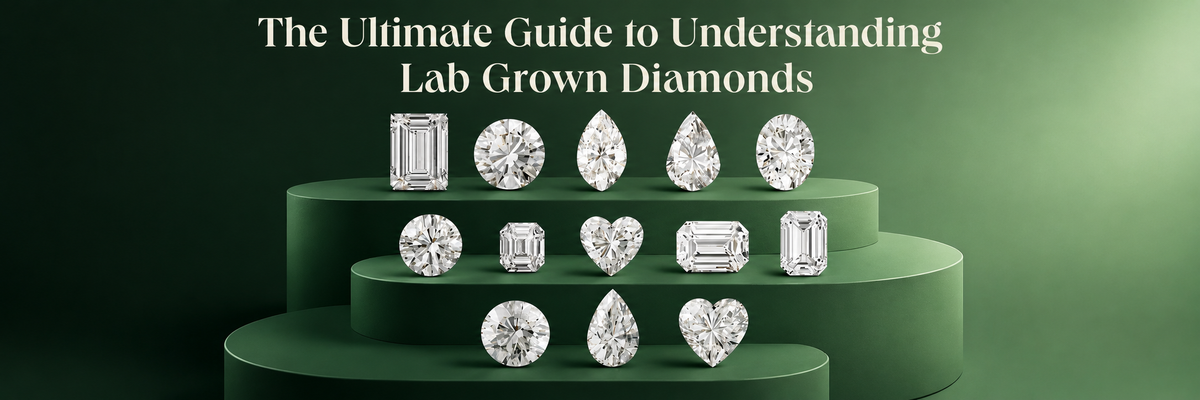
If you have been shopping for jewelry lately, you have probably come across the term "lab grown diamonds." More and more people are choosing them, and the reasons are simple: lower price, fewer questions about where the stone came from, and the same physical makeup as a mined diamond. But what are lab grown diamonds, really? And should you buy one for your next ring, pendant, or gift?
This guide walks you through everything you need to know. We will cover what lab created diamonds are, how they are made, how they compare to natural diamonds, and how to pick the right one for your budget and style. By the end, you will understand the topic well enough to shop with confidence, whether you are buying from Lumera Fine Jewellery or anywhere else.

Lab grown diamonds are diamonds that form inside a facility instead of coming out of the ground, and once you get past that one difference, everything else about them is the same as what you'd find in a mined stone. People sometimes hear "lab grown" and assume it means fake or man made in some artificial sense, but that's not accurate at all.
The carbon inside a lab grown diamond bonds together in the exact same crystal pattern as a diamond pulled from a mine, which is why gemologists classify both as real diamonds rather than treating one as an imitation of the other. Growers use two main methods to make this happen, HPHT and CVD, and in some cases a grower will actually combine both methods on a single stone, starting the diamond with one process and finishing it with the other to get better control over size, clarity, or growth speed.
This mixed method approach is becoming more common as labs look for ways to produce higher quality diamonds in less time. At the end of the day, whether a diamond was grown using HPHT, CVD, or a mix of the two, you end up with a stone that's chemically and physically identical to one dug out of the earth, just made on a different timeline and in a different place.

Yes, and this is probably the number one question people ask before they even start looking at rings or earrings, because nobody wants to spend their money on something that isn't the real deal. Here's the simple truth: a lab grown diamond is made of the exact same stuff as a mined diamond, carbon, arranged in that same tight crystal pattern that makes diamonds so hard and so good at bending light.
It scores the same on the hardness scale, it holds up the same way over years of wear, and it reacts to light the same way a mined stone does, which means there's no real difference in how it looks or performs day to day. The one and only difference is where the diamond came from, one grew underground over a very long stretch of time, the other grew inside a facility over a matter of weeks or months. That's it.
Jewelers don't treat lab grown diamonds as some kind of knockoff, and neither do gemologists or the labs that grade them. They're graded on the same scale, held to the same standards, and labeled as genuine diamonds on the paperwork, just with a note saying how they were grown.

A lot of people mix up lab grown diamonds with things like moissanite or cubic zirconia, and honestly, it's an easy mistake to make since all three get sold in the jewelry world and all three can look pretty good in a ring, but they're not the same thing at all, and knowing the difference matters if you want to know exactly what you're buying.
Moissanite is made from silicon carbide, and cubic zirconia is made from zirconium dioxide, so right off the bat neither one is actually carbon, which means neither one shares the crystal structure that makes a diamond a diamond in the first place. Because of that, both simulants handle light differently than a real diamond does, they don't wear the same way over the years, and a trained eye can usually spot the difference between one of them and an actual diamond without too much trouble.
A lab grown diamond doesn't have any of these issues, because it's made of carbon, arranged the same way a mined diamond is arranged, which is why it isn't fair to lump it in with simulants or call it some kind of dressed up fake. It's a real diamond, just grown somewhere other than underground.
There are two main ways growers actually make a diamond in a lab, HPHT and CVD, and while the equipment and setup look pretty different between the two, they both start the same way, with a tiny seed of diamond that acts as the starting point, and they both end the same way too, with a full grown diamond crystal that's ready to be cut and polished.

HPHT stands for High Pressure High Temperature, and it works pretty much the way it sounds, a diamond seed gets placed inside a chamber along with a carbon source, and then that chamber gets cranked up with extreme heat and extreme pressure at the same time, basically copying the same kind of conditions that exist way down under the earth's surface where diamonds naturally form. As all that heat and pressure does its work, carbon atoms start bonding onto the seed, and little by little, that seed grows into a full diamond crystal.

CVD stands for Chemical Vapor Deposition, and it takes a different route to get to the same result. Instead of pressure, a diamond seed gets placed inside a sealed chamber that's filled with a carbon rich gas, and once that gas gets heated up, it breaks apart, and the carbon starts settling onto the seed one thin layer at a time, slowly building up into a diamond over the course of the process. A lot of growers like CVD because it gives them more control over how big the stone gets and how clean the final quality turns out.
Growing a diamond isn't something that happens overnight, no matter which method a grower uses. Depending on how big the stone needs to be and how high the quality needs to come out, the whole process can take anywhere from a few weeks on the shorter end to a couple of months on the longer end. As a general rule, the bigger and higher quality the diamond, the more time it takes to grow.

To really get why lab grown diamonds look and act just like mined ones, it helps to slow down for a second and look at what's actually going on inside the stone at a basic level.
Every diamond out there, whether it grew underground or inside a lab, is made almost entirely of one thing, carbon. What makes diamond so tough isn't the carbon by itself, it's how tightly those carbon atoms pack together, and that tight packing is what gives diamond the toughness it's known for.

Inside a diamond, the carbon atoms line up in a repeating pattern that scientists call a crystal lattice, and each atom locks in tight with four others sitting around it. That repeating, locked-in pattern is the real reason diamond ends up being one of the hardest materials found on earth.
Since lab grown diamonds share that exact same crystal lattice as mined diamonds, they end up sharing the same physical traits too. Both score a 10 on the Mohs hardness scale, which is as high as that scale goes, and both bend and reflect light the same way, which is a big part of what shapes how a diamond actually looks once it's cut and set in a ring.

Those bright flashes of light you notice when you look at a diamond happen because light enters the stone, bounces around inside it, and then exits back out toward your eye, and that whole effect is what gemologists call brilliance and fire. Because lab grown diamonds have the same crystal lattice as mined ones, light moves through them the exact same way. So a lab grown diamond that's cut well is going to show off the same brilliance as a mined diamond that's cut just as well.

Now that you've got a handle on what lab grown diamonds are and how they actually form, let's put them side by side with natural diamonds and go through the things buyers care about most when they're deciding between the two.
|
Factor |
Lab Grown Diamonds |
Natural Diamonds |
Origin |
Formed in a facility over a few weeks to a few months |
Formed underground over 1 to 3 billion years |
Appearance |
Looks identical to a natural diamond; only specialized equipment can tell them apart |
Same appearance, look, and light performance as a lab grown stone |
Durability |
Same 10 on the Mohs hardness scale; scratches, chips, and wears the same as a mined diamond |
Same 10 on the Mohs hardness scale |
Price |
60% to 80% cheaper than a natural diamond of the same size and quality |
Higher price for the same size and quality |
Environmental Impact |
Less land disturbance; smaller footprint depending on the facility's power source |
Mining disturbs large amounts of land and nearby water sources |
Ethical Considerations |
Made in a monitored facility with an easy-to-track supply chain |
Sourcing history varies; some regions tied to conflict or unsafe labor conditions |

No matter if a diamond came out of the ground or grew inside a lab, its quality gets measured the exact same way, using four factors called the 4Cs, cut, color, clarity, and carat weight. These four things together decide how a diamond looks and how much it's going to cost you.
Cut is all about how well the angles and proportions of a diamond are shaped, and that's a different thing from the shape of the stone itself, so don't mix the two up. A diamond that's cut well reflects light in a way that makes it shine bright and look strong under any light. A diamond that's cut poorly can end up looking flat and dull, even if everything else about it, the color, the clarity, the size, checks out just fine.
Diamond color gets graded on a scale that runs from D all the way down to Z, with D being completely colorless and Z carrying a pretty obvious yellow or brown tint. If you're after that clean, colorless look, most buyers stick to diamonds in the D to H range.
Clarity is about marks, either the kind that show up inside the stone, called inclusions, or the kind that show up on the surface, called blemishes. Grading runs from Flawless, meaning nothing shows up even under magnification, all the way down to Included, where the marks are noticeable enough to see with just your eyes.
Carat weight is simply a measurement of size, not a measurement of quality, so don't assume a bigger carat number automatically means a better diamond. One carat comes out to 200 milligrams, and while a heavier carat weight usually pushes the price up, two diamonds with the same exact carat weight can look completely different from each other depending on how they were cut and what their color and clarity grades are.

Certification is what tells you exactly what you're putting your money into, and honestly, it's not something you want to skip if you're looking for real peace of mind on a purchase like this.
A grading report from an independent lab spells out the diamond's cut, color, clarity, and carat weight, and it also confirms whether the stone is natural or lab grown. Without that report in hand, you're basically just trusting whatever the seller happens to tell you, and that's not a great position to be in when you're spending real money.
The International Gemological Institute, better known as IGI, is one of the most commonly used labs out there for grading lab grown diamonds. An IGI report breaks down all four of the 4Cs in detail and states flat out that the diamond in question is lab grown.
The Gemological Institute of America, or GIA, is another well-respected lab that certifies both natural and lab grown diamonds. GIA has built its reputation on strict, consistent grading, so no matter what type of diamond you're looking at, the standards stay the same across the board.
A grading report is going to lay out the diamond's shape, its measurements, its carat weight, and its color, clarity, and cut grades, plus a diagram that plots out exactly where any inclusions sit inside the stone. For lab grown diamonds, it'll also note the growth method, whether that's HPHT, CVD, or a mix of both. Taking a few minutes to actually read through this report before you buy tells you exactly what you're getting for your money, no guesswork involved.

There are a handful of practical reasons buyers keep moving toward lab grown diamonds, and none of them are complicated.
Lab grown diamonds cost a good deal less than mined diamonds of the same grade, so buyers end up with room in their budget to go bigger on the stone or bump up the quality without spending more than they planned.
Since lab grown diamonds get made in a controlled setting from start to finish, buyers don't have to worry about the labor problems or land issues that sometimes come attached to mining operations in certain parts of the world.
Growing a diamond disturbs a lot less land than digging one out of the ground. If you're someone who thinks about your environmental footprint before making a purchase, that's a real factor worth weighing.
Lab grown diamonds get graded against the exact same 4C standards as natural diamonds, so a high grade lab grown stone is built just as well as a high grade mined stone, no corners cut.
Since it costs less to produce a lab grown diamond, buyers have more room to try out different shapes or go up in carat size without pushing their budget further than they're comfortable with.

A handful of misconceptions still hang around when it comes to lab grown diamonds, so let's clear them up one by one.
Not true at all. A lab grown diamond is chemically identical to a mined one, right down to the atom. The term "lab grown" just tells you where the diamond formed, it has nothing to do with what the diamond is actually made of.
Also not true. Brilliance comes down to a diamond's cut and its crystal structure, and both of those are identical whether the stone is lab grown or mined. So a lab grown diamond that's cut well is going to perform under light exactly the same as a mined diamond that's cut well.
False. Lab grown diamonds land on the same 10 on the Mohs hardness scale as mined diamonds, so they wear, scratch, and hold up over the years in exactly the same way.
Also false. Labs like IGI and GIA certify lab grown diamonds using the same 4C standards they use for natural stones, the only difference is the report includes a note confirming how the diamond was grown.

If you're ready to actually go buy one, here's a simple process that makes the whole thing a lot less overwhelming.
Figure out how much you're comfortable spending before you even start browsing. This one step alone narrows things down fast and keeps you from getting talked into features you don't really care about, just because they're there.
Think about which of the 4Cs matters most to you personally. Some buyers care more about getting a bigger stone, others would rather have a diamond that's completely colorless or one with a really clean clarity grade. Once you know what you care about most, it's a lot easier to make trade-offs on the rest.
Diamonds come in a bunch of popular shapes, round, oval, princess, emerald, pear, and cushion, just to name a few, and each one has its own look along with its own price per carat. It's worth trying on a few different shapes in person before you settle on one.
Make sure the diamond you're looking at comes with an IGI or GIA grading report. That report backs up exactly what you're buying and saves you from any confusion or disappointment later on.
The setting you choose changes how the diamond actually looks once it's in your hand. Some popular options include a solitaire, a halo, a three stone design, a hidden halo, or a pavé band. At Lumera Fine Jewellery, you can browse through a range of these settings paired with certified lab grown diamonds until you find the one that fits your style.

Lab grown diamonds show up in pretty much every type of jewelry you can think of at this point.
This is by far the most common use. Lab grown diamond engagement rings let buyers walk away with a bigger stone or a higher grade one without having to stretch their budget nearly as far as they would with a mined diamond.
Diamond wedding bands set with lab grown stones give you the same look and the same durability as bands set with mined diamonds, just for less money.
Lab grown diamond earrings have become a go to everyday piece, since the lower cost makes it a lot easier to spring for bigger stones or a full matching set instead of settling for something smaller.
Diamond pendants and necklaces set with lab grown stones give buyers more room to size up on the stone without seeing a big jump in the price tag.
A diamond tennis bracelet set with lab grown stones is a good example of how buyers put that lower per-carat price to use, since it lets them afford a full row of diamonds instead of just one or two.

Lab grown diamonds need the exact same care as mined diamonds, since they share the same hardness and the same structure underneath it all.
Soak the piece in warm water with just a small amount of mild dish soap, then gently go over it with a soft toothbrush to work loose any buildup that's collected around the setting. Rinse it off well and dry it with a soft cloth when you're done.
Keep your diamond jewelry stored away from your other pieces to avoid scratches, since diamond is hard enough to scratch just about anything else, including another diamond. A box lined with fabric or a soft pouch does the job well.
Get your jewelry looked at by a professional once or twice a year. It's a quick way to catch loose prongs or worn down settings before they turn into a bigger issue, and it keeps the piece looking its best for a long time.
Explore our premium collection of lab grown diamond engagement rings, wedding bands, earrings, necklaces, bracelets, pendants, and fine jewelry. Discover ethical luxury, exceptional brilliance, and timeless designs crafted for every occasion.
Shop All Lab Grown Diamond JewelryLab grown diamonds give buyers a practical way to own a genuine diamond without paying the higher price tag that comes with a mined stone. They share the same chemical makeup, the same hardness, and the same brilliance as natural diamonds, and they come backed by the same certification standards from labs like IGI and GIA.
When you're ready to buy, keep your focus on the 4Cs, pick a shape and setting that actually fits your style, and always ask for a certified grading report before you commit. Whether you're shopping for an engagement ring, a pair of earrings, or a gift for someone you care about, Lumera Fine Jewellery offers certified lab grown diamonds built to give you real quality at a fair price. Once you understand these basics, you're in a strong position to buy with confidence instead of guessing.
Yes, laboratory-grown diamonds are real diamonds. They are made of pure carbon and are chemically, physically, and optically identical to earth-mined diamonds. They share the same sparkle, rank a 10 on the Mohs hardness scale, and are evaluated using the same 4Cs (cut, color, clarity, carat).
Yes, lab-grown diamonds are absolutely worth buying if you want a chemically and visually identical diamond but want to save 30% to 70% compared to natural stones. They share the exact same brilliance, sparkle, and Mohs hardness of 10, making them incredibly durable for everyday wear like an engagement ring.
The primary downsides to lab-grown diamonds are their lack of long-term resale value, rapid price depreciation due to mass production, and a high energy footprint during manufacturing. Additionally, some buyers feel they lack the historical rarity and heirloom prestige of natural stones.
Many jewelers are hesitant to sell lab-grown diamonds because of plunging wholesale prices, which result in shrinking profit margins and depreciating store inventory. Furthermore, the mass-produced nature of synthetic diamonds threatens the traditional industry model built on natural scarcity, meaning many jewelers are unwilling to buy them back.
Yes, affluent individuals increasingly purchase lab-grown diamonds. Rather than settling for smaller or lower-quality natural stones, wealthy buyers leverage the 60% to 85% price reduction to acquire significantly larger, flawless diamonds. Many view this as a smart financial strategy rather than a budget constraint.
Tiffany diamonds are exclusively natural and mined, not lab-grown. The luxury jeweler's stance is that lab-made stones lack the rarity and intrinsic romance of natural diamonds, so they do not use them in their jewelry.
A 1-carat lab-grown diamond typically costs between $500 and $3,000, with the average stone falling right around $800 to $1,500 depending on the cut, color, and clarity.
Yes, lab-grown diamonds last exactly as long as natural diamonds. Because they share the exact same physical, optical, and chemical properties, they will never fade, cloud, or scratch during everyday wear.

