Cart
0
🎉 Congratulations! You unlocked Complimentary Gift.

Solitaire round cut diamond stud earrings
$0
$ 0


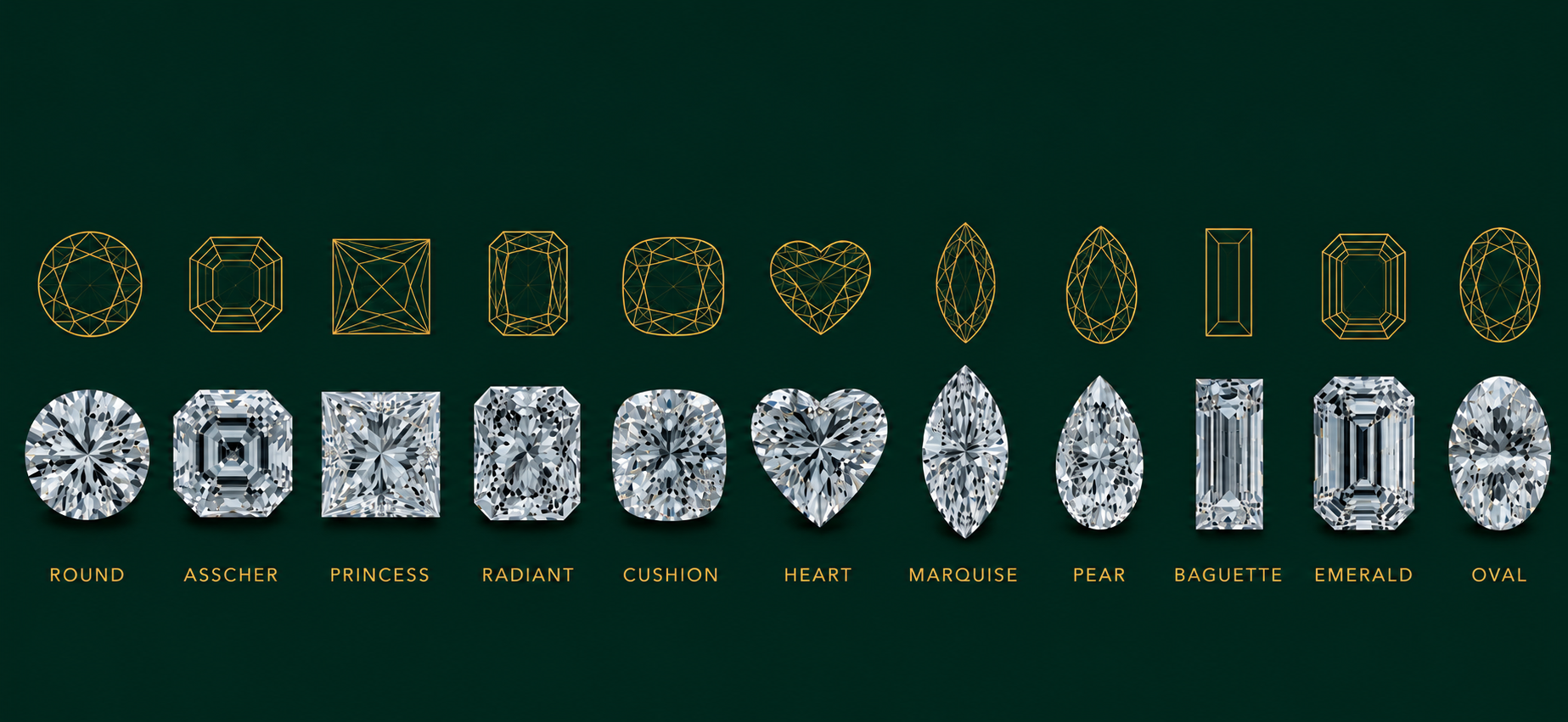
Picking a diamond is a big decision, and the shape you pick changes everything about how the ring looks. Two diamonds can be the exact same size and price, but if one is round and one is oval, they will look completely different on a hand.
At Lumera Fine Jewellery, this is the question we get asked more than any other: "Which diamond shape should I pick?" So we put together this guide to walk you through every diamond shape, how they compare, and how to figure out which one is right for you.
When people talk about diamond shapes, they mean the outline of the diamond when you look at it from above. Round, oval, square, and heart are all diamond shapes. The shape is what you notice first when you look at a ring, before you even think about anything else.
Diamond shape is not the same thing as diamond cut, and a lot of people mix these two up. We'll clear that up in the next section.


This is one of the most confusing parts of buying a diamond, so let's break it down simply.
Shape is the outline of the diamond, like round, oval, or emerald.
Cut is how well the diamond is shaped and polished to catch light. Cut is graded (Excellent, Very Good, Good, Fair, Poor) and it's what actually controls how much a diamond sparkles.
So you could have two round diamonds, and one has a much better cut grade than the other. Same shape, very different sparkle.


| Term | What It Means | What It Affects |
|---|---|---|
| Shape | The outline (round, oval, square, etc.) | How the diamond looks overall |
| Cut | How well the diamond is shaped and polished | How much light and sparkle it gives off |
Before we go through each shape one by one, here's a quick chart so you can compare them side by side.
| Shape | Sparkle | Price | Popularity | Best For | Looks Larger |
|---|---|---|---|---|---|
| Round | Highest | Highest | Most popular | Classic looks | No |
| Princess | High | Mid-High | Very popular | Modern, square looks | No |
| Oval | High | Mid | Very popular | Elongated fingers | Yes |
| Cushion | Medium-High | Mid | Popular | Soft, rounded corners | Some |
| Emerald | Lower (more glassy shine) | Mid-High | Popular | Long, clean lines | Yes |
| Radiant | High | Mid | Growing in popularity | Bold, brilliant look | Some |
| Pear | High | Mid | Popular | Unique, teardrop look | Yes |
| Marquise | High | Mid-Low | Less common | Longest-looking finger effect | Yes, the most |
| Asscher | Lower (more glassy shine) | Mid-High | Less common | Vintage style | No |
| Heart | High | Mid | Least common | Romantic style | No |
Now let's go through each shape in detail. For each one, we'll cover what it looks like, how it sparkles, the pros and cons, what ring settings work best, and what to know before buying it.
Overview: The round brilliant is the most popular diamond shape in the world, and it has held that spot for decades. It's a classic circle shape cut with 58 facets, which are small flat surfaces cut into the diamond to reflect light.
Key Characteristics: The round shape is symmetrical, which makes it easy to set in almost any ring style.
Sparkle: Out of every diamond shape, round diamonds sparkle the most. The round brilliant cut was designed specifically to bounce light back out through the top of the stone.


Solitaire, halo, and pave settings all work well with round diamonds.
Round diamonds look good on almost every finger shape, but they work especially well on longer fingers.
Because more of the rough diamond is cut away to make this shape, round diamonds usually cost more per carat than other shapes.
Since round diamonds are the most costly, ask for the cut grade first, because that's what really determines the sparkle.
Overview: The princess cut is a square-shaped diamond with pointed corners. It's the second most popular diamond shape after round.
Key Characteristics: Sharp, clean corners give it a modern, geometric look.
Sparkle: Princess cuts sparkle a lot, close to round diamonds, because they also use a brilliant-style facet pattern.


A four-prong setting that protects the corners works best.
Princess cut diamonds suit shorter fingers because the square shape adds width.
Princess cut diamonds are generally 10–25% cheaper than round diamonds of the same size.
Look for a setting with corner protection, since the pointed edges are the weakest part of this shape.
Overview: The oval cut is a stretched-out version of the round brilliant. It has the same sparkle style as round but in a longer shape.
Key Characteristics: The elongated shape makes the diamond look bigger than its actual carat weight.
Sparkle: Oval diamonds sparkle almost as much as round diamonds.


Solitaire and halo settings both highlight the length of an oval diamond well.
Oval diamonds are one of the best choices for shorter or wider fingers, since the elongated shape creates a slimming effect.
Oval diamonds typically cost less per carat than round diamonds, making them an excellent value.
Ask to see the diamond in person or in a high-quality video before buying so you can check for a noticeable bow tie shadow and ensure the stone has even brilliance.
Overview: The cushion cut is a square or rectangle shape with rounded corners, kind of like a pillow. It's been around for over 100 years and has come back into style recently.
Key Characteristics: Soft, rounded edges give it a gentle, old-fashioned look compared to sharper shapes like princess.
Sparkle: Cushion cuts have good sparkle, though it can look more like a mix of bright flashes and softer light depending on how it's cut.


Halo settings are extremely popular with cushion cuts, since the extra small diamonds around the edge add more sparkle.
Elongated cushion cuts work well on shorter fingers.
Mid-range, generally less than round diamonds.
Decide between a square cushion or elongated cushion first, since they look very different on the hand.
Overview: The emerald cut is a rectangle shape with cut corners and long, flat facets, called step cuts, instead of the small triangle facets used in round diamonds.
Key Characteristics: Instead of sparkle, emerald cuts give off a clear, glassy flash of light, sometimes called the "hall of mirrors" effect.
Sparkle: Lower sparkle than round or oval, but a distinct, striking flash when it does catch light.


Simple solitaire settings let the long lines of an emerald cut stand out.
Great for shorter fingers because of the elongating effect.
Similar to or slightly less than round diamonds.
Since flaws show up more easily in this shape, choose a higher clarity grade than you would for a round diamond.
Overview: The radiant cut is a rectangle or square shape with cut corners, combining the clean lines of an emerald cut with the sparkle pattern of a round brilliant.
Key Characteristics: It's basically a middle ground between the emerald cut and the princess cut.
Sparkle: Radiant cuts sparkle a lot more than emerald cuts, since they use the brilliant facet pattern.


Works well in both solitaire and halo settings.
Good for most finger types thanks to its balanced shape.
Mid-range, usually more affordable than round diamonds.
Radiant cuts are a good pick if you want strong sparkle but don't want the pointed corners of a princess cut.
Overview: The pear shape, also called a teardrop diamond, is a mix between a round and a marquise shape, rounded on one end and pointed on the other.
Key Characteristics: One of the more unique and recognizable diamond shapes.
Sparkle: Strong sparkle, close to round diamonds, because of the similar facet pattern.


A V-shaped prong at the point protects the tip from chipping.
Great for shorter or wider fingers because of the slimming, elongated shape.
Mid-range, generally less than round diamonds.
Check the ratio between the length and width, since a pear that's too short can look stubby.
Overview: The marquise cut is a long, narrow shape with pointed ends on both sides, similar to a football shape.
Key Characteristics: Out of every diamond shape, marquise diamonds create the biggest look for their actual carat weight.
Sparkle: Strong sparkle thanks to the brilliant-style facets.


Prongs at both points are a must to protect the tips.
One of the best shapes for shorter or wider fingers.
Often one of the more affordable shapes per carat.
Because the shape stretches out the look of the stone, you can often go with a smaller carat weight and still get a big look.
Overview: The Asscher cut is a square version of the emerald cut, with cut corners and step-cut facets. It was first created in 1902 and is known as a vintage-style shape.
Key Characteristics: Deep step-cut facets create a layered, geometric pattern instead of the typical scattered sparkle.
Sparkle: Lower sparkle than round or oval, similar to the emerald cut, with more of a flash than a scatter of light.


Simple, vintage-inspired settings suit this shape best.
Works well on most finger types because of its balanced square shape.
Similar to emerald cut pricing.
Go for a higher clarity grade, since flaws are easier to spot in this shape.
Overview: The heart shape is exactly what it sounds like, a diamond cut into the outline of a heart. It's the least common of the popular diamond shapes, and often chosen for its meaning as much as its look.
Key Characteristics: Requires very precise cutting to get symmetrical lobes and a clean point.
Sparkle: Strong sparkle, similar to round and pear diamonds.


A V-prong at the bottom point, similar to a pear cut, protects the tip.
Works best on longer fingers, since the shape needs some visual space to read clearly as a heart.
Similar to pear cut pricing.
Look at the diamond in person if possible, since photos can hide a poorly shaped heart cut.
Here's a second comparison chart looking at durability alongside the other factors.
| Shape | Sparkle | Durability | Cost | Popularity | Looks Bigger |
|---|---|---|---|---|---|
| Round | Highest | High | Highest | Highest | No |
| Princess | High | Medium (pointed corners) | High | High | No |
| Oval | High | High | Medium | High | Yes |
| Cushion | Medium-High | High | Medium | High | Some |
| Emerald | Medium | High | Medium-High | Medium | Yes |
| Radiant | High | High | Medium | Growing | Some |
| Pear | High | Medium (one point) | Medium | Medium | Yes |
| Marquise | High | Medium (two points) | Medium-Low | Lower | Yes, most |
| Asscher | Medium | High | Medium-High | Lower | No |
| Heart | High | Medium (one point) | Medium | Lowest | No |
If sparkle is your top priority, round brilliant diamonds win. The round brilliant cut was designed with math in mind, specifically to send light back out through the top of the diamond in a way other shapes can't fully copy.
Close behind round, you'll find oval, pear, marquise, and heart shapes, since they all use a similar brilliant facet pattern just stretched into different outlines.
On the other end, emerald and Asscher cuts sparkle less, because their step-cut facets create fewer, larger flashes of light instead of many small ones. That's not a bad thing, it's just a different kind of shine, more like a mirror than a firework.
This is a common question, and the answer usually surprises people: a round diamond is not the biggest-looking shape for its carat weight.
Elongated shapes like marquise, oval, and pear spread the same amount of diamond across more surface area, so they look bigger when you look at the ring from above, even at the same carat weight as a round diamond.
Marquise diamonds create the biggest visual size out of every shape, followed closely by oval and pear. This is why these three shapes are popular picks for buyers working with a smaller budget who still want a ring that reads as large.
Round diamonds are almost always the most expensive shape per carat. That's because cutting a round diamond wastes more of the original rough diamond material than other shapes.
Shapes like princess, marquise, oval, and pear use more of the rough diamond during cutting, which means less waste and a lower price per carat.
If you're working with a tighter budget, marquise and oval shapes give you the best combination of a lower price per carat and a bigger visual size. You get more ring for the same money.

Different diamond shapes can change how your hand and fingers look. Here's a simple breakdown.
Short Fingers: Elongated shapes like oval, marquise, pear, and emerald create a slimming, lengthening effect.
Long Fingers: Round, cushion, and princess cuts all look great on longer fingers, since these shapes don't need the extra elongation.
Wide Fingers: Marquise and oval shapes are two of the best choices, since their narrow, pointed ends visually slim down the finger.
Slim Fingers: Cushion and princess cuts can add a bit of width and balance to slimmer fingers.
The ring setting you choose should work with your diamond shape, not against it.
Solitaire: Round, oval, princess, and emerald cuts all look clean and simple in a solitaire setting, since there's nothing else pulling focus away from the shape.
Halo: Cushion, oval, and round diamonds are the most common choices for halo settings, since the small diamonds around the edge add extra sparkle to shapes that already sparkle well.
Three Stone: Oval and round diamonds work best here, since the side stones need to match the main stone's outline closely.
Vintage: Asscher and emerald cuts are the most natural fit for vintage-style rings, since their step-cut facets match the era these settings originally came from.
Hidden Halo: Round and oval diamonds work best, since the hidden diamonds underneath the main stone add sparkle without changing the outline from above.
Bezel: Round and oval shapes are the easiest to set in a bezel, which is a setting that wraps metal fully around the diamond's edge for extra protection.
There's no single "best" diamond shape, only the best shape for you. Here's what to think about before deciding:
Budget: If you want the biggest look for the lowest cost, look at oval or marquise shapes instead of round.
Lifestyle: If you work with your hands a lot, rounded shapes without sharp points (round, oval, cushion) are more durable day to day.
Personal Style: Think about whether you're drawn to classic shapes (round, princess) or something more unique (marquise, pear, heart).
Finger Shape: Use the finger type guide above to pick a shape that flatters your hand.
Ring Setting: Some shapes pair better with certain settings, so it helps to pick your shape and setting together instead of separately.
Daily Wear: If the ring will be worn every day, protective settings like prongs on pointed shapes matter more than they might seem.
At Lumera Fine Jewellery, we usually recommend trying on a few different shapes in person before deciding, since photos and charts can only tell you so much. A shape that looks great in a picture might feel completely different on your own hand.
Here's what's trending in diamond shapes for 2025:
Round: Still the most requested shape, and that isn't changing anytime soon.
Oval: Oval diamonds have grown steadily in popularity over the past several years and remain one of the top picks for engagement rings in 2025.
Elongated Cushion: This softer, stretched-out version of the cushion cut has become a popular alternative to both oval and traditional cushion shapes.
Radiant: More buyers are choosing radiant cuts as a way to get strong sparkle in a shape that isn't as common as round or princess.
Pear: Pear shapes continue to grow in popularity, especially set at a slight angle, called an east-west setting.
Buying a diamond can be stressful, so here are the mistakes we see most often at Lumera Fine Jewellery.
Choosing Only By Trend: A shape that's trending right now might not be the shape you love in ten years. Pick a shape you personally connect with.
Ignoring Finger Shape: The same diamond shape can look completely different depending on the person's hand, so try shapes on before deciding.
Not Considering Sparkle: Some buyers assume all diamond shapes sparkle the same way. As you've seen in this guide, that's not true, and it's worth understanding before you buy.
Ignoring Ring Setting: Picking a shape and a setting separately, without thinking about how they'll look together, is one of the most common regrets buyers mention.
Buying Without Certification: Always ask for a grading certificate from a lab like GIA or AGS. This confirms the diamond's cut, clarity, color, and carat weight are accurate.
Browse our complete collection of lab grown diamond jewelry, including engagement rings, wedding bands, earrings, necklaces, bracelets, and more. Find handcrafted designs in your choice of solid gold or platinum.
Shop All Diamond Jewelry →There's no single diamond shape that's right for everyone. Round diamonds sparkle the most and hold their value best. Oval and marquise shapes look bigger for less money. Emerald and Asscher cuts offer a cleaner, more understated shine. Heart and pear shapes bring in a more personal, unique touch.
The best next step is to try a few shapes on in person, since that's the only real way to know how a diamond shape will look on your own hand. If you'd like help finding the right shape for your budget and style, the team at Lumera Fine Jewellery is happy to walk you through your options one on one.
Diamond shapes are just the outline of the stone when you look at it from above. You've got the classic round cut, and then a bunch of "fancy" shapes like oval, pear, marquise, cushion, and almond. The longer shapes, like almond, tend to look bigger than they actually are, and their pointed edges catch light in a different way than a round stone does.
If you want something flattering, elongated shapes like almond, oval, marquise, and pear are usually the go-to picks. Because they're long instead of round, they pull the eye down the finger, which makes hands look longer and slimmer.
There isn't really one "rarest" shape, but anything outside the usual round or princess cut counts as uncommon, since round alone makes up more than half the market. That's actually part of the appeal of an almond engagement ring; barely anyone else is wearing one.
Emerald, cushion, and princess cuts tend to be the cheapest, mostly because cutting them wastes less of the original rough stone. Almond and oval land somewhere in the middle on price, and both often look bigger per carat than a round diamond of the same weight.
Marquise diamonds usually get the credit for looking biggest per carat, with oval and almond shapes right behind them. Their long, pointed shape just covers more space across the finger than a round or cushion cut would at the same weight.
It's a ring set with a diamond cut to look like an almond nut, long with soft curves on the sides and a point at each end. Think of it as landing right between an oval and a marquise, a little rounder than one, a little fuller than the other.
Yes, it's a great middle-ground option if you want that elongated look but don't want to go as narrow as a marquise or as fully rounded as an oval. You get pointed tips for a bit of edge, plus enough width in the middle so it doesn't look too thin.
Definitely. Lab grown diamonds are the same, chemically and physically, as natural ones, just priced lower. That usually means you can get a bigger or better-quality almond diamond without stretching your budget as much.

