Cart
0
🎉 Congratulations! You unlocked Complimentary Gift.

Solitaire round cut diamond stud earrings
$0
$ 0


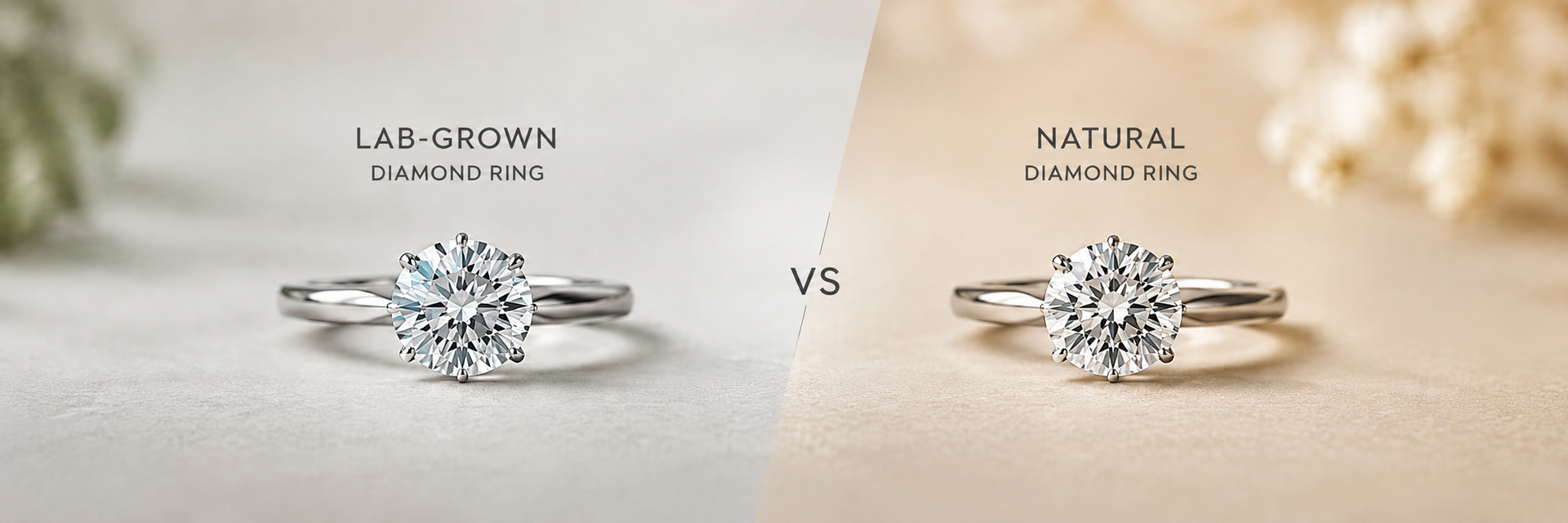
So you're shopping for a diamond ring. Maybe it's an engagement ring. Maybe it's a birthday gift. Maybe you just want something beautiful for yourself. Either way, you've probably run into two options: lab-grown diamonds and natural diamonds.
And honestly? It can feel super confusing.
Are lab-grown diamonds fake? Are natural diamonds worth the price? Which one sparkles more? Is one better than the other?
Don't stress. At Lumera Fine Jewellery, we get this question every single day. And in this blog, we're going to break it all down for you super simple, zero confusion, just real talk.
By the end of this post, you'll know exactly what the difference is, which one fits your budget, and which one is the right choice for YOU.
Look, most people think of a diamond as just a shiny, expensive rock. But there's actually a wild story behind every single one. A diamond is pure carbon — that's it. The same stuff in your pencil. The difference? How those carbon atoms are stacked together. And that tiny difference in structure is what makes a diamond the hardest thing on Earth and the most sparkly thing you'll ever put on your finger.

A diamond is made of just ONE element: carbon. That's it. The same carbon that's in a pencil (graphite), the same carbon in your body, the same carbon in coal.
In graphite (pencil), carbon atoms are arranged in flat layers that slide against each other. That's why it's soft and leaves marks on paper.
In a diamond, carbon atoms are arranged in a super tight pyramid-shaped 3D structure every single carbon atom is bonded to 4 other carbon atoms in a rigid cage-like pattern. This is called a diamond cubic crystal structure.
This tight bonding is what makes diamonds:
• The hardest natural substance on Earth (10/10 on the Mohs hardness scale)
• Incredibly dense and stable
• Transparent - light passes through cleanly rather than getting absorbed
This tight bonding is what makes diamonds:
• The hardest natural substance on Earth (10/10 on the Mohs hardness scale - nothing scratches a diamond except another diamond)
• super dense and stable
• Transparent - light passes through cleanly rather than getting absorbed

Here's the science behind the sparkle and it's actually really cool.
When light enters a diamond, three things happen:
1. Brilliance - White light reflects back out of the top of the diamond like a mirror. This is the bright white flashes you see.
2. Fire - The diamond splits white light into all the colors of the rainbow (red, orange, yellow, green, blue, violet) just like a prism. Those colorful flashes? That's fire.
3. Scintillation - When you move the diamond, it twinkles. Those little sparkle-flashes when light catches it at different angles? That's scintillation.
All three of these effects happen because of diamond's extremely high refractive index (2.42). Refractive index basically means how much a material bends light. Diamond bends light way more than glass or water - which is why it sparkles so much more than glass or water .
And here's the key: both lab-grown and natural diamonds have the exact same refractive index. The sparkle is identical. Not similar identical. Because the crystal structure is the same.

Yes! Gemologists actually classify diamonds into types based on what trace elements (if any) are present inside the carbon structure:
Type Ia - Most natural diamonds. Contain clusters of nitrogen atoms. Slightly yellowish tint.
Type IIa - The rarest and purest natural diamonds. Almost zero nitrogen. Colorless and stunningly brilliant. The Hope Diamond is Type IIa.
Type IIb - Contain boron instead of nitrogen. These are the famous blue diamonds (like the Hope Diamond).
Most lab-grown diamonds made by CVD are Type IIa meaning they're actually purer than most natural diamonds. That's a fun fact most people don't know!

Here's something that'll blow your mind — the diamond ring you're looking at right now? It's older than dinosaurs. Way older. Natural diamonds don't get made overnight. They're born deep inside the Earth, under crazy heat and pressure, and they take over a billion years to form. That's not a typo. A billion years. Every natural diamond you see has been on an insane journey just to get to your finger.

The journey of a natural diamond starts about 100 to 200 miles below the Earth's surface, in a layer called the mantle. Down there, the temperature is around 2,000°F (1,100°C) and the pressure is about 725,000 pounds per square inch. That is pressure so extreme it's hard to imagine millions of times more than what you feel on the surface.
Under those extreme conditions, carbon atoms that exist in the mantle slowly bond together and crystallize into diamonds. This process takes anywhere from 1 billion to 3.3 billion years. To put that in perspective:
• Earth itself is only 4.5 billion years old
• Dinosaurs went extinct 66 million years ago
• The oldest human civilization is about 6,000 years old
• Your natural diamond ring is older than all of that combined

Diamonds don't mine themselves to the surface over billions of years. They get a ride a very violent ride.
Deep underground, there are volcanic structures called kimberlite pipes named after Kimberley, South Africa, where they were first discovered. These are ancient volcanic channels that formed when molten rock (magma) shot upward through the Earth's crust at incredibly high speeds.
This volcanic eruption happened so fast and so violently that it carried diamonds up from the mantle and deposited them in cone-shaped underground rock formations called kimberlite pipes.
Here's what's wild: most kimberlite eruptions happened more than 70 million years ago. So the "elevator" that brought diamonds to mineable depths ran millions of years ago and now humans dig down to find what was left behind.

Diamond mining is a massive, complex operation. There are three main types:
1. Open-Pit Mining
A huge cone-shaped pit is dug into the earth. This is the most common method. The Jwaneng mine in Botswana is the richest diamond mine in the world it's a pit so large you can see it from space.
2. Underground Mining
When the diamond-bearing rock goes too deep for open-pit mining, tunnels are dug underground to access the kimberlite pipe from inside.
3. Alluvial Mining
Over millions of years, erosion can wash diamonds out of kimberlite pipes into riverbeds, beaches, and ocean floors. Alluvial mining involves sifting through river sediments, sand, or ocean floors to find these scattered diamonds. Some of the most famous diamonds in history including many huge, flawless stones were found this way.

No two natural diamonds are exactly alike. Here's why:
Inclusions - As a diamond crystallizes over billions of years, tiny crystals, gas bubbles, or structural distortions get trapped inside. These are called inclusions. Every diamond has a different set of inclusions like a fingerprint.
Growth patterns - The exact temperature, pressure, and chemical conditions during formation affect the crystal's shape and internal grain patterns.
Trace elements - Small amounts of nitrogen, boron, or hydrogen can affect the diamond's color and fluorescence in ways unique to each stone.
This is why natural diamond lovers often talk about their stone being truly one-of-a-kind. The GIA certificate for your diamond describes YOUR stone's specific characteristics no other diamond on Earth has exactly those inclusions in exactly that arrangement.

From deep underground to your finger, a natural diamond goes through a long journey:
• Mining - Extracted from kimberlite rock using heavy machinery
• Sorting - Rough diamonds are sorted by size, shape, and quality
• Planning - Gemologists use advanced scanning tech to decide the best way to cut each rough diamond
• Cleaving or Sawing - The rough stone is split along its crystal structure
• Bruting - Diamonds are rounded into shape by spinning them against each other
• Polishing - Skilled artisans polish the facets (flat faces) on the diamond to maximize sparkle
• Grading - Sent to a gemological lab (GIA, IGI, ACC) for official quality certification
• Setting - The polished diamond is set into your ring
From rough stone to finished ring, this process can take months and the diamond itself took over a billion years to form. That's the story behind every natural diamond.

So what if scientists could skip the billion-year wait? That's exactly what lab-grown diamonds are. Real scientists, in a real lab, figured out how to copy what the Earth does naturally — and pull it off in just a few weeks. The result is a diamond that looks the same, feels the same, and IS chemically the same as a natural one. Not a fake. Not a copy. A real diamond, just grown above ground instead of below it.
The core idea behind lab-grown diamonds is simple: if we understand HOW nature makes diamonds (extreme heat + extreme pressure + carbon + time), can we recreate those conditions in a controlled environment?
And the answer is YES, and the result is a real, genuine diamond. Not a diamond simulant. Not a fake. An actual diamond.
Scientists have been growing diamonds in labs since the 1950s originally for industrial use (diamond-coated drill bits, cutting tools, etc.). But it wasn't until the 2000s and 2010s that the technology became good enough to produce gem-quality diamonds suitable for jewelry.
Today, lab-grown diamonds are now a massive, fast-growing industry.

HPHT is the older of the two methods, developed in the 1950s by General Electric. Here's how it works step by step:
Step 1: The Seed
A tiny sliver of diamond (called a "diamond seed") is placed at the bottom of a specially designed press. This seed is just a few millimeters in size.
Step 2: Surrounding Carbon
The seed is surrounded by a highly purified carbon source, usually graphite. This is the "food" that will feed the growing diamond.
Step 3: Extreme Conditions
The press applies:
• Temperature: around 2,700°F (1,500°C)
• Pressure: around 1.5 million pounds per square inch
These conditions mimic what happens in the Earth's mantle.
Step 4: Growth
The extreme heat melts the graphite. The carbon atoms from the melted graphite attach to the diamond seed and slowly build up, layer by layer, growing the diamond.
Step 5: Cooling and Extraction
After several days to weeks, the press is cooled. The grown diamond is removed and then sent for cutting, polishing, and grading just like a natural diamond.
HPHT diamonds often have a slightly yellowish or brownish tint due to nitrogen in the process. They're also sometimes used to "treat" lower-quality natural diamonds by using HPHT to improve their color.

CVD is the newer, more advanced method and it's now the go-to method for producing gem-quality lab diamonds today. It's a bit more technical but also really cool.
Step 1: The Chamber
A diamond seed (thin diamond wafer) is placed inside a sealed vacuum chamber.
Step 2: The Gas Mix
The chamber is filled with a mixture of gases, primarily methane (CH₄) and hydrogen (H₂). Methane is a carbon-rich gas. This is the carbon source for the diamond.
Step 3: Activation
The gas mixture is activated using a microwave beam or laser. This breaks apart the gas molecules and turns the methane into a plasma (a superheated cloud of ionized gas) reaching temperatures of around 1,800–3,600°F.
Step 4: Carbon Rain
The broken-apart carbon atoms in the plasma have nowhere to go so they fall onto the diamond seed below and begin attaching to it. Carbon atom by carbon atom, layer by layer, the diamond literally grows from the bottom up—kind of like 3D printing, but with atoms.
Step 5: Weeks of Growth
This process runs for 2 to 4 weeks for a 1 carat diamond. The result is a rough diamond crystal that looks like a thick, cloudy cube or column.
Step 6: Post-Processing
CVD diamonds often come out with a brownish color due to structural defects. They're typically treated with a quick HPHT process afterward to remove this color and make them near-colorless.
Step 7: Cutting, Polishing & Grading
Just like a natural diamond, skilled cutters shape the rough into a brilliant stone, then it's sent to IGI or GIA for certification.
| Feature | HPHT | CVD |
|---|---|---|
| Method | Extreme pressure + heat | Carbon gas plasma |
| Shape | Cuboctahedral | Cubic/flat plate |
| Color | Slight yellow/brown | Near-colorless |
| Purity | Good | Excellent (Type IIa) |
| Speed | 1–2 weeks | 2–4 weeks |
| Cost | Lower | Slightly higher |
| Best for | Industrial + jewelry | Gem-quality jewelry |
Most high-quality lab-grown diamond jewelry today, including pieces from Lumera Fine Jewellery, uses CVD diamonds because of their better purity and color.
Here's a surprising fact: CVD lab-grown diamonds are often PURER than most natural diamonds.
Most natural diamonds contain nitrogen impurities (Type Ia). CVD diamonds are typically Type IIa - which means near-zero nitrogen making them chemically purer than the majority of natural diamonds on the market.
This purity is actually a way trained gemologists can sometimes identify lab-grown diamonds not with the naked eye, but with specialized spectrometry equipment that detects the absence of nitrogen or specific growth patterns.

With the naked eye: No. Not a chance. Even highly experienced jewellers cannot look at a lab-grown diamond and identify it.
With basic jeweller's tools (loupe, microscope): Still no. The inclusions in a CVD diamond look just like natural inclusions.
With specialized equipment (UV fluorescence, infrared spectroscopy, photoluminescence testing): Yes - trained gemologists using advanced machines can identify lab-grown diamonds by detecting specific growth patterns or the absence of nitrogen.
This is why GIA and IGI always note "laboratory-grown" on their certificates for lab diamonds not because you can see it, but because full transparency is important when you're spending thousands of dollars.
At Lumera Fine Jewellery, every lab-grown diamond comes with its full IGI or GIA certificate, so you always know exactly what you're getting.
Absolutely NOT. This is the biggest myth out there.
Lab-grown diamonds are NOT:
Lab-grown diamonds ARE:
The Federal Trade Commission (FTC) in the US officially recognizes lab-grown diamonds as real diamonds. So yeah, they're legit!
So now you know what both are. Same sparkle. Same hardness. Same material. But there ARE real differences and those differences could save you thousands of dollars or help you make the smartest ring decision of your life. Let's get into it, factor by factor.
| Feature | Lab-Grown Diamond | Natural Diamond |
|---|---|---|
| Origin | Made in a laboratory | Formed deep in the Earth |
| Time to Form | 2-6 weeks | 1–3 billion years |
| Chemical Composition | Pure carbon | Pure carbon |
| Hardness | 10/10 Mohs scale | 10/10 Mohs scale |
| Sparkle/Brilliance | Identical | Identical |
| Price | 70–85% less expensive | Higher price |
| Resale Value | Lower resale value | Higher resale value |
| Environmental Impact | Lower mining impact | Significant mining required |
| Rarity | Can be produced anytime | Rare and finite |
| Certification | GIA, IGI certified | GIA, IGI, AGS certified |
| Detectability | Only with special equipment | Only with special equipment |
| Unique/One-of-a-Kind | Nearly identical stones possible | Every stone is unique |
| Ethical Concerns | Minimal | Conflict diamonds possible |
| Best For | Budget-conscious, large stones | Sentimentality, investment, tradition |
Okay, let's be real: price is probably one of the first things on your mind.
Here's the straight-up truth:
Lab-grown diamonds cost 50% to 80% LESS than natural diamonds of the same size and quality.
Let's put that in real numbers:
• A 1 carat natural diamond ring might cost around $5,000 to $8,000
• A 1 carat lab-grown diamond ring of the same quality might cost $1,200 to $2,500
That's a massive difference. What does that mean for you? It means with the same budget, you can get a MUCH bigger or higher-quality lab-grown diamond. Instead of a 0.5-carat natural diamond, you could get a gorgeous 1.5-carat lab-grown diamond for the same money.
At Lumera Fine Jewellery, we always say: "More diamond for your dollar or more dollars in your pocket."
This is everyone's favorite question. And the honest answer is: they sparkle exactly the same.
Sparkle (technically called "brilliance" and "fire" in the diamond world) comes from how a diamond is CUT, not where it came from. The way light bounces inside the stone and reflects back to your eye that's all about the cut quality.
A well-cut lab-grown diamond jewelry will outshine a poorly-cut natural diamond every single time.
So when you're shopping with Lumera Fine Jewellery, always focus on the cut grade above everything else. An Excellent or Ideal cut = maximum sparkle. Period.

Both lab-grown and natural diamonds are graded using the 4Cs. Here's what they mean in simple terms:
How well the diamond has been shaped and faceted. This is the #1 factor for sparkle. Always go for "Excellent" or "Very Good" cut grades.
How colorless the diamond is. The scale goes from D (totally colorless) to Z (yellowish). For most rings, G–H is the sweet spot that looks white, but costs way less than D–F.
How many tiny inclusions (internal flaws) the diamond has. VS1–VS2 clarity is great for most people the flaws are invisible to the naked eye.
How big the diamond is (by weight). 1 carat = 0.2 grams. Bigger doesn't always mean better cut and color matter too.
Pro tip from Lumera Fine Jewellery: For lab-grown diamonds, you can often afford to go up a carat size thanks to the lower price. Use that savings on a higher cut grade!

Here's where we'll be totally honest with you.
Natural diamonds hold their resale value better than lab-grown diamonds.
Natural diamonds, especially high-quality ones, have historically held their value reasonably well over decades. A really exceptional natural diamond can even appreciate in value.
Lab-grown diamonds are newer to the market, and as more and more labs produce them, the prices have been dropping. This means the resale value isn't as strong.
BUT and this is important, most people don't buy engagement rings to sell them later. They buy them to wear and love for a lifetime.
If you're buying a diamond as a financial investment, nature is better. If you're buying a diamond as a symbol of love or beauty, the sparkle is identical and lab-grown gives you more for your money.
At Lumera Fine Jewellery, we always tell customers: "Buy what makes your heart happy."
This is a big topic for a lot of younger buyers today. And rightfully so!

• Requires moving massive amounts of earth and rock
• Can disrupt local ecosystems and wildlife
• Uses significant amounts of water and energy
• Has improved significantly in ethics and sustainability practices
• Programs like the Kimberley Process help prevent "conflict diamonds"
• No large-scale land disruption
• No mining required
• Does use significant electricity (though some labs use renewable energy)
• Generally considered the more environmentally friendly option
• No concerns about conflict or "blood diamonds"
For eco-conscious shoppers, lab-grown diamonds are often the preferred choice. Lumera Fine Jewellery offers certified lab-grown diamonds from facilities that prioritize sustainable energy practices.

You might've heard the term "blood diamond" it refers to diamonds mined in war zones and sold to finance armed conflict, often with serious human rights violations involved.
This is a real concern with some natural diamonds, though the industry has come a long way.
• Always ask for a Kimberley Process Certification
• Look for certified conflict-free diamonds
• Buy from reputable jewellers like Lumera Fine Jewellery who verify their supply chain
Lab-grown diamonds have zero risk of being conflict diamonds they're made in a lab, no mining, no human rights issues related to extraction.
Prefer a personal touch? Let our gemologists guide you through your diamond journey.
Book Virtual AppointmentLab-grown diamonds are perfect for you if…
Natural diamonds are perfect for you if…
Discover brilliance without compromise. Explore our premium collection of lab-grown diamonds rings.
Shop Lab-Grown Diamonds RingsLab-grown diamonds now make up over 50% of engagement ring sales in the US - especially among millennials and Gen Z buyers.
Why? Because people are getting smarter about where they spend their money. They want the same beauty and quality, but they're not willing to overpay just for a marketing label. Plus, the ethical and environmental factors matter more to younger generations.
That said, natural diamonds still hold a very special place in the market. There's something deeply romantic about wearing a stone that was formed on the Earth billions of years ago.
At Lumera Fine Jewellery, we sell both and we'll never push you toward one or the other. Our job is to help you find YOUR perfect diamond.
At Lumera Fine Jewellery, we believe every diamond tells a story. Whether you choose a lab-grown diamond or a natural diamond, the moment you put it on your finger that story becomes yours.
We offer:
Whether you're shopping for an engagement ring, anniversary gift, or just treating yourself - Lumera Fine Jewellery has the perfect diamond waiting for you.
Here's the simple truth:
Both lab-grown and natural diamonds are REAL diamonds. They sparkle the same. They're graded the same. They're certified the same. They're made of the same stuff.
The difference is in the story behind them.
A natural diamond carries billions of years of Earth's history on its finger. A lab-grown diamond carries the story of human ingenuity and gives you more carats for your cash.
Neither one is "better." They're just different. And the right one for you depends on what matters most to YOU.
At Lumera Fine Jewellery, we're here to help you find that perfect stone, the one that matches your story, your style, and your budget.
Because at the end of the day, the most important thing isn't where the diamond came from. It's what it means to the person wearing it.
Neither is better — they're just different. Lab-grown diamonds give you the same sparkle and hardness at 70–85% less cost. Natural diamonds offer geological rarity and stronger resale value. The better choice depends on your budget, values, and what the ring means to you.
Lab-grown diamonds have near-zero resale value since they can be mass-produced anytime. They also lack the geological rarity of natural diamonds. Some buyers feel they carry less sentimental weight though physically and chemically, they are 100% identical to mined diamonds.
No. Lab-grown diamonds are not fake they are real diamonds. Even professional jewellers cannot tell the difference with the naked eye. They have the same brilliance, fire, and hardness as natural diamonds. A well-cut lab-grown diamond will outshine a poorly-cut natural diamond every single time.
Yes — especially if you want a bigger, higher-quality stone for your budget. Lab-grown diamonds now make up over 50% of engagement ring sales in the US. They are GIA and IGI certified, real diamonds, and a smart choice for buyers who prioritize size, quality, and ethical sourcing over resale value.
The 4Cs are Cut, Color, Clarity, and Carat — the four factors that determine a diamond's quality and price. Cut is the most important for sparkle. Color grade D–Z measures how colorless the stone is. Clarity measures internal flaws. Carat measures the diamond's weight and size. Both lab-grown and natural diamonds are graded on the same 4Cs scale.
Yes — celebrities increasingly choose lab-grown diamonds for red-carpet events and engagement rings. The reason is simple: they get a physically identical, larger, and flawless stone for a fraction of the cost while also making an ethical and sustainable choice. At Lumera Fine Jewellery, we offer the same certified lab-grown stones available to anyone.
Remove your diamond ring before washing hands, showering, swimming, or applying lotion and perfume. Chemicals and soaps break down metal settings over time especially prong-set rings. Clean your ring every 2–4 weeks using warm water and a soft brush. Store it separately to avoid scratches from other jewelry.
Not with the naked eye not even trained jewellers can. The only way to identify a lab-grown diamond is with specialized equipment like UV fluorescence testing or infrared spectroscopy. This is why GIA and IGI certify lab-grown diamonds separately on their grading reports for full transparency when you're spending thousands of dollars.
Lab-grown diamonds are not ideal as a financial investment since their resale value has dropped significantly due to mass production. Natural diamonds hold value better over time. However, if you're buying a ring to wear and love not to resell a lab-grown diamond gives you more stone for your money with zero compromise on beauty.
The best engagement ring diamond depends on your priorities. For maximum size and budget, go lab-grown you can get a 1.5 carat lab diamond for the same price as a 0.5-carat natural one. For tradition, rarity, and long-term value, go natural. Either way, always prioritize an Excellent cut grade that's what controls the sparkle. Lumera Fine Jewellery carries both, fully certified.


