Cart
0
🎉 Congratulations! You unlocked Complimentary Gift.

Solitaire round cut diamond stud earrings
$0
$ 0


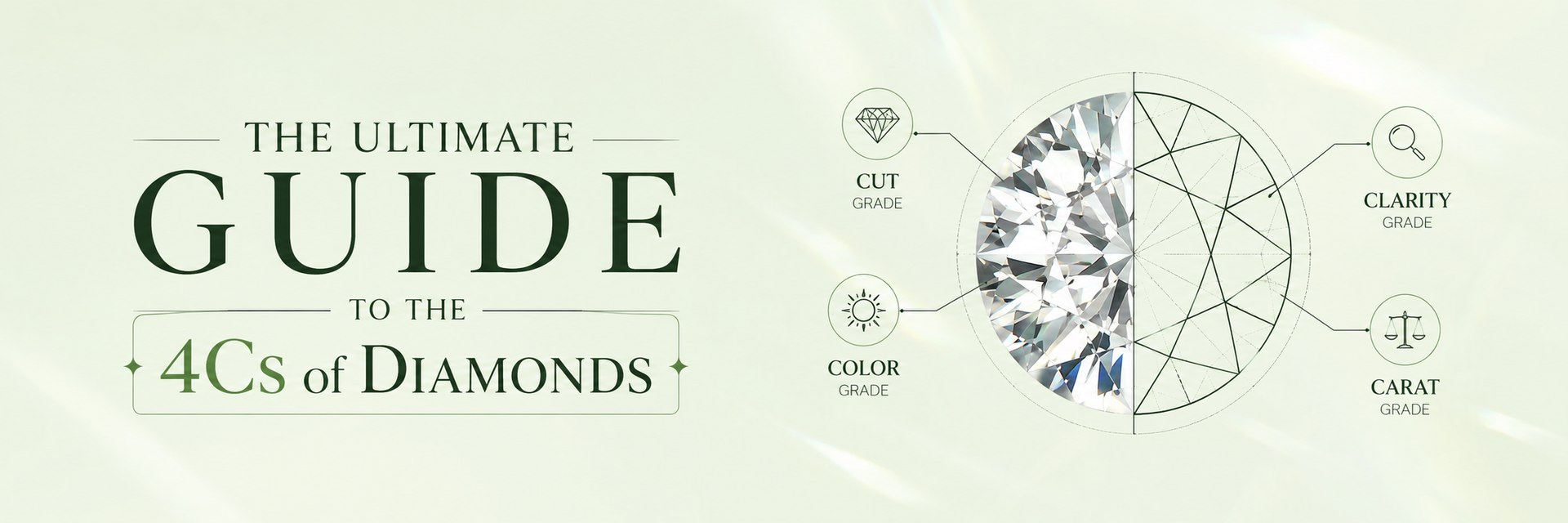
If you are shopping for a diamond - whether for an engagement ring, a gift, or yourself - you have probably heard about the 4Cs. But what exactly are they, and how do you actually use them when buying a diamond?
This guide breaks down everything you need to know about diamond Cut, Color, Clarity, and Carat Weight. By the end, you will know how to read a diamond grading report, what questions to ask, and how to get the best diamond for your budget - without overpaying for qualities you cannot even see.
At Lumera Fine Jewellery, we work with customers every day who walk in confused about the 4Cs and walk out confident in their choice. This guide is built on those same conversations.

The 4Cs - Cut, Color, Clarity, and Carat Weight - are the four standard factors used to describe and grade a diamond. They were developed by the Gemological Institute of America (GIA) in the mid-20th century and are now used by grading laboratories worldwide.
Before the 4Cs existed, buying a diamond was guesswork. There was no shared language, no standard system, and no reliable way to compare one diamond to another. The GIA changed that by creating a universal grading system that any buyer, jeweler, or lab could use.
Here is why the 4Cs matter: two diamonds can look almost identical on the outside but be priced thousands of dollars apart. The 4Cs explain why. They also help you make trade-offs - for example, choosing a slightly lower color grade so you can afford a better cut, which actually makes a bigger difference in how the diamond looks.
Understanding the 4Cs means you stop buying on gut feeling alone and start making informed decisions.

A lot of people confuse cut with shape. Shape is the outline of the diamond - round, oval, princess, pear, cushion, and so on. Cut is something different. It refers to how well the diamond has been faceted - how precise the angles, proportions, and symmetry are.
Cut is what controls how light moves through the diamond. When light enters a well-cut diamond, it bounces around inside and exits through the top in a way that creates brightness and visual interest. When cut is poor, light leaks out the sides or bottom, and the diamond looks dull even if it is colorless and flawless.
GIA grades round brilliant diamonds on a cut scale:
Excellent - The best. Light performance is outstanding. These diamonds are bright, lively, and visually striking. They are also priced higher.
Very Good - Very close to excellent in performance. A smart choice if you want to save a little money without a noticeable drop in appearance.
Good - Still reflects a good amount of light. You may notice a slight difference compared to excellent cuts, but many buyers are happy with this grade at lower price points.
Fair - Cut quality starts to affect the look. Light leakage becomes more noticeable.
Poor - Significant light loss. The diamond will look noticeably dull. Not recommended.
When jewelers and gemologists say cut is the most important C, this is why:
Brilliance is the overall white light reflected from the diamond. A well-cut diamond sends that light straight back to your eye.
Fire is the colored flashes you see - those flickers of blue, orange, and red. This comes from the diamond breaking white light into its spectrum, which only happens correctly when the angles are right.
Scintillation is the pattern of light and dark as the diamond moves. A well-cut diamond shifts and dances when you look at it from different angles.
No amount of perfect color or clarity will fix a poorly cut diamond. But an excellent cut can make a slightly lower color or clarity grade look stunning.
For round brilliants, aim for Excellent or Very Good cut at minimum.
For fancy shapes (oval, cushion, pear), GIA does not grade cut the same way, so look for length-to-width ratios and request light performance videos before buying.
If budget is tight, drop down one grade in color or clarity before sacrificing cut quality.
Diamond color does not mean the color of a fancy colored diamond like blue or pink. In the standard grading system, color refers to the absence of color in white diamonds. The more colorless a diamond is, the higher it grades.
Most diamonds have at least a trace of yellow or brown so faint you might not notice it at all. The grading system measures how much of that tint is present.

GIA grades diamond color from D to Z
D–F (Colorless) - Diamonds in the D-F color range are exceptionally rare and represent the highest standard of color quality, with no visible tint even under close inspection. They display maximum brilliance and a crisp, icy-white appearance, making them an ideal choice for platinum and white gold settings. While the differences between D, E, and F grades are extremely subtle and nearly impossible to see without professional equipment, all three are considered premium-quality diamonds.
G–J (Near Colorless) - Diamonds graded G-J appear colorless to the naked eye in most lighting conditions, especially after they are set in jewelry. They offer an excellent balance of beauty, quality, and value, making them one of the most popular choices for engagement rings. G and H grades are particularly sought after because they provide a bright white appearance at a significantly lower price than colorless D-F diamonds.
K–M (Faint Color) - Diamonds in the K-M range have a subtle warm tint that becomes noticeable in certain lighting, especially when viewed face-up or from the side. Many buyers find this warmth attractive in yellow or rose gold settings because it creates a soft, rich appearance while still maintaining good brilliance. In platinum or white gold settings, however, the slight yellow tint may stand out more, making the diamond appear less icy-white compared to higher color grades.
N–R (Very Light Color) - Diamonds in the N-R range have a noticeable yellow or brown tint that becomes visible even to the untrained eye, especially when compared to higher color grades. While they offer excellent value, the visible color can slightly reduce the stone's brilliance and icy-white appearance. These diamonds are often chosen for vintage-style jewelry or warm-toned settings like yellow and rose gold, where the tint is less noticeable.
S–Z (Light Color) - Diamonds graded S-Z have a strong, easily visible yellow or brown tint that significantly affects their overall appearance. They are among the most affordable natural diamonds because the color is obvious in most lighting conditions. These diamonds are best suited for buyers prioritizing size and budget over a colorless look, particularly in yellow gold settings where the tint blends more naturally
The setting you choose matters a lot here. In yellow gold, a G or H diamond (or even I or J) will look perfectly white because the warm metal reflects into the stone. In platinum or white gold, a lower color grade will show more tint.
Diamond size also plays a role. The larger the diamond, the more surface area there is to show color. In diamonds over 1.5 carats, you may notice a difference between D-F and G-J. In diamonds under 0.75 carats, the difference is often invisible.
Maximum value: G or H in a yellow gold setting. You get a near-colorless look at a noticeably lower price than D-F.
Platinum or white gold settings: G or H still works. Go to F if you want complete peace of mind.
Tight budget: I or J, especially in yellow gold or rose gold, can be an excellent choice.
At Lumera Fine Jewellery, we often recommend G or H color to customers who want a white-looking diamond without paying the premium for colorless grades.
Diamonds form under extreme pressure and heat deep in the earth. During that process, tiny natural imperfections get trapped inside or on the surface of the stone. These are called inclusions (internal) and blemishes (external).
Clarity grades how many of these imperfections exist, how large they are, where they are located, and how they affect the overall look of the diamond.

FL (Flawless) - No inclusions or blemishes visible under 10x magnification. Extremely rare and expensive. Less than 1% of gem-quality diamonds reach this grade.
IF (Internally Flawless) - No inclusions, only minor surface blemishes under 10x magnification. Still extremely rare.
VVS1–VVS2 (Very Very Slightly Included) - Inclusions are so small they are very difficult to see even under magnification. Virtually undetectable to the naked eye.
VS1–VS2 (Very Slightly Included) - Inclusions are minor and difficult to see under magnification. Completely invisible to the naked eye in almost all cases.
SI1–SI2 (Slightly Included) - Inclusions are noticeable under magnification. SI1 diamonds are usually eye-clean. SI2 may or may not be, depending on the specific stone. you need to look at it closely.
I1–I3 (Included) - Inclusions are visible to the naked eye. They may affect the appearance and sometimes the durability of the diamond. Generally not recommended for center stones.
Eye-clean means you cannot see any inclusions without magnification when looking at the diamond from a normal viewing distance (about 6-12 inches). This is the practical standard most buyers should aim for.
Here is the key insight: you are not paying for a laboratory to find inclusions under a microscope. You are paying for a diamond that looks beautiful in real life. If you cannot see the inclusions with your eyes, paying extra for a higher clarity grade does not change how the diamond looks to you or anyone else.
VS1–VS2 is almost always eye-cleaning. Most SI1 diamonds are eye-clean. Some SI2 diamonds are eye-clean. FL and IF are overkill for most buyers - you are paying for perfection that only shows up under a loupe.
For most buyers: VS2 or SI1 is the sweet spot. These grades offer diamonds that are clean to the naked eye at prices significantly lower than VVS or FL grades.
If you are buying a large diamond (2 carats or more), go for VS1 or higher, because inclusions become more visible in larger stones.

Carat is the unit of weight used to measure diamonds. One carat equals 0.2 grams. It is divided into 100 points so a 0.50 carat diamond is sometimes called a 50 pointer.
Carat weight is often misunderstood as size. It is not the same thing. Two diamonds can weigh the same but look very different sizes depending on how they are cut.
Carat weight has a major impact on price and the relationship is not linear. Diamonds at magic numbers like 0.50, 0.75, 1.00, and 1.50 carats are priced at a premium because demand spikes at those weights.
A 0.97-carat diamond and a 1.00 carat diamond look nearly identical, but the 1.00 carat stone can cost 15–20% more just because of the round number. Buying just below these thresholds is one of the best ways to save money.
The face-up size (what you actually see when you look at the ring) depends on:
Carat weight
Cut (a deep cut diamond carries more weight in the bottom, so it looks smaller face-up)
Shape (oval and marquise shapes tend to look larger face-up than round brilliants of the same carat weight)
This is why two 1-carat diamonds can look noticeably different sizes. A well-cut 0.90-carat round brilliant can actually look bigger than a poorly proportioned 1.10-carat stone.
| Carat Weight | Round Brilliant Diameter (Approx.) | Face-Up Look Compared to Weight | Best Use Case |
|---|---|---|---|
| 0.50 ct | 5.1 mm | Looks accurate to weight | Budget-friendly stud or accent stone |
| 0.70 ct | 5.7 mm | Slightly smaller if deep cut | Good middle-ground for solitaire rings |
| 0.90 ct | 6.2 mm | Can look equal to or larger than a poorly cut 1.00 ct | Best value pick – just under the "magic number" |
| 1.00 ct | 6.4 mm | Standard reference size, but price jumps sharply here | Buyers focused on the round number milestone |
| 1.20 ct | 6.8 mm | Noticeably larger face-up, especially in oval or pear shapes | Strong visual upgrade from 1 ct |
| 1.50 ct | 7.4 mm | Clearly larger, but another "magic number" price spike | Buyers prioritizing visible size |
| 2.00 ct+ | 8.1 mm+ | Large stones where cut quality and clarity matter most | Statement rings; inclusions and color become more visible |
Buy just below magic numbers (e.g., 0.90-0.95 instead of 1.00 carats).
Consider fancy shapes like oval or elongated cushion - they often look larger face-up for the same weight.
Do not sacrifice cut quality to get a bigger carat weight. A smaller better-cut diamond will outperform a larger dull one.
No single C tells you whether a diamond is beautiful. They all interact.
Here is a simple example: a 2-carat diamond graded I1 clarity with a Fair cut might be cheaper than a 1.20-carat diamond graded VS1 with an Excellent cut - but the second diamond will almost certainly look better in real life.
The goal is balance. Spending all your budget chasing carat weight while ignoring cut quality is one of the most common mistakes buyers make.
A good framework: lock in Excellent or Very Good cut first, then choose the best color and clarity your budget allows then decide on carat weight with whatever is left.
Cut - without much debate. Here is why: the other three Cs are about the diamond's natural properties. Cut is entirely about craftsmanship. A skilled cutter can take a rough stone with slightly warm color and minor inclusions and produce a diamond that looks stunning. A poor cut can ruin a colorless, flawless stone.
That said, your priorities may shift depending on the situation:
If color is very important to you (you strongly prefer icy white diamonds), prioritize F or G color.
If you want a larger-looking diamond on a budget, you might prioritize carat weight and accept a slightly lower clarity grade.
If you have a larger budget all four Cs can be high, and you have less to trade off.
Focus on cut quality above everything else. Look for round brilliants in the G–I color range, SI1–SI2 clarity, and 0.40–0.60 carats. Verify the diamond is eye-clean before buying.
You have more flexibility. Aim for Excellent cut, G–H color, VS2–SI1 clarity, in the 0.60–0.90 carat range. This is where you start to see genuinely beautiful diamonds.
Excellent cut, F–H color, VS1–VS2 clarity, and 0.90–1.30 carats is very achievable. Consider buying just under 1.00 carat to save significantly.
You can prioritize all four Cs at higher levels. Excellent cut, E–G color, VS1 or better clarity, and 1.20+ carats. At this range, consider GIA-certified stones and compare multiple options carefully.
Diamond Certification and Grading Reports

A diamond grading report from an independent laboratory tells you exactly what you are getting. It confirms the 4Cs grades, provides a plot of inclusions, and verifies the diamond has not been treated or misrepresented.
Without certification, you are trusting the seller's word. Even honest jewelers use grading reports because it protects both the buyer and the seller.
Never buy a significant diamond without a grading report. This applies whether you are spending $500 or $50,000.
GIA (Gemological Institute of America) - The gold standard. GIA grades are highly consistent and widely trusted. If you can only accept one lab's certification, this is it.
AGS (American Gem Society) - Another highly respected lab, especially known for its detailed cut grading system. AGS uses a 0–10 scale (0 being the best) rather than GIA's Excellent–Poor scale.
IGI (International Gemological Institute) - Widely used for lab-grown diamonds. IGI reports are generally accepted, though some buyers and resellers place higher value on GIA for natural diamonds.
A GIA report includes:
Shape and cutting style (e.g., "Round Brilliant")
Measurements in millimeters
Carat weight
Color grade
Clarity grade
Cut grade (for round brilliants)
Polish and symmetry grades
Fluorescence - whether the diamond glows under UV light (mild fluorescence is generally not a problem)
Clarity plot - a diagram showing where inclusions are located
Cross-reference the report number with the lab's online database to confirm it is authentic. GIA allows free report verification at their website.
Myth: Bigger diamonds are always better. Not true. A well cut 0.90 carat diamond can look more impressive and cost less than a poorly cut 1.20 carat stone.
Myth: Higher clarity always means a better-looking diamond. Not if the diamond is already eye-clean. A VS2 and a VVS1 may look identical in real life. You are paying for a difference that is only visible under magnification.
Myth: Colorless diamonds (D–F) are the only good diamonds. G and H color diamonds are virtually indistinguishable from D-F to the naked eye, especially once set in a ring. Many buyers at Lumera Fine Jewellery choose G or H and are completely happy with the result.
Myth: Carat determines quality. Carat is weight. A large, poorly cut, included diamond is not a high quality diamond regardless of its size.
Myth: Expensive diamonds are always the best choice. Price reflects a combination of the 4Cs plus market demand. You can find beautiful diamonds by understanding how to balance the 4Cs rather than just picking the most expensive option.
Explore our complete collection of handcrafted diamond, gold, and silver jewelry. From timeless classics to modern designs, discover beautifully crafted pieces made to celebrate every special moment.
Explore Our Jewelry Collection ✨Focusing only on carat weight. Carat weight is the easiest number to compare but the least important one to maximize. Many buyers regret buying a big, dull diamond when they could have had a smaller- more vivid one.
Ignoring cut quality. Cut is the hardest C to evaluate without experience, so some buyers skip it. Do not. It is the most important factor in how the diamond looks.
Paying for clarity you cannot see. If a VS2 and a VVS1 both look clean to your eye the extra money for VVS1 does not improve your experience of the diamond.
Buying without certification. This is a risk that is not worth taking, regardless of how much you trust the seller.
Not comparing multiple diamonds. Even within the same grade, diamonds vary. Look at multiple options, request video in different lighting and compare before deciding.
Cut first: Aim for Excellent or Very Good for round brilliants.
Eye-clean clarity: VS2 or SI1 for most buyers. Check the stone - do not just rely on the grade.
Near-colorless color: G or H gives you a white-looking diamond at a good price.
Carat weight: Buy just below magic numbers to save money without giving up visible size.
Certification: Only consider GIA, AGS, or IGI certified diamonds.
Compare: Look at multiple stones before committing.
The 4Cs - Cut, Color, Clarity, and Carat Weight - give you a structured way to evaluate any diamond. But the real skill is not in choosing the highest grades across all four. It is in understanding how they work together so you can make smart trade-offs based on your priorities and budget.
Start with a cut. Protect your budget by choosing an eye-clean clarity grade and a near-colorless color. Be strategic about carat weight. And always buy certified.
At Lumera Fine Jewellery, we believe every customer deserves to understand exactly what they are buying. A diamond is a meaningful purchase, and knowing the 4Cs puts you in a much stronger position - whether you are buying your first diamond or your tenth.
Take your time, compare certified options side by side, and focus on what you can actually see. The perfect diamond is the one that looks beautiful to you within a budget you are comfortable with.
Every piece of jewelry tells a story, and yours should be one of a kind. Whether you're dreaming of a custom engagement ring, a meaningful pendant, a personalized bracelet, or a timeless gift, our expert designers will bring your vision to life with exceptional craftsmanship and premium materials. Start your custom jewelry journey today and create something you'll cherish forever.
Custom Your JewelryThe 4Cs of a diamond are Cut, Color, Clarity, and Carat Weight. Established by the Gemological Institute of America (GIA), these four characteristics are the global standard for grading any diamond's quality, rarity, and value. Cut measures how well a diamond is faceted and how it handles light. Color grades the absence of yellow or brown tint on a D-to-Z scale. Clarity measures internal and external imperfections. Carat Weight measures the diamond's mass, where one carat equals 0.2 grams.
Cut is the most important of the 4Cs. Cut determines how well a diamond reflects light -its brightness, fire, and visual liveliness. A poorly cut diamond will look dull even if it has excellent color and clarity grades. A well-cut diamond with slightly lower color or clarity grades will often look more impressive in real life. Gemologists widely agree that cut has the biggest impact on a diamond's overall appearance.
The best clarity grade for most buyers is VS2 or SI1. These grades offer eye-clean diamonds – no visible inclusions to the naked eye - at a much lower price than VVS or FL grades. For diamonds under 1.5 carats, a good SI1 is often completely clean to the eye and represents strong value. For larger diamonds (1.5 carats and above), VS2 gives more confidence that inclusions will not be visible. FL and IF grades are extremely rare and priced accordingly, but they look identical to VS1 and VS2 in real-world conditions.
The best diamond color grade for value is G or H. These grades fall in the near-colorless range (G-J on the GIA scale) and look white to the naked eye, especially once set in a ring. The price difference between a G and a D-color diamond of the same cut and clarity can be 20-40% or more, with virtually no visible difference. In yellow gold or rose gold settings, I or J color can also work well because the warm metal minimizes any slight tint in the stone.
Cut and shape are not the same thing. Shape refers to the outline of the diamond - round, oval, princess, cushion, pear, marquise, and so on. Cut refers to how well the diamond has been faceted - the precision of its angles, proportions, and symmetry. Cut determines how light moves through the stone and how bright it looks. Two round diamonds can have the same shape but very different cut grades, and the better-cut stone will look noticeably brighter and more alive.
Yes, Certified diamonds are easier to verify, price fairly, and resell. A grading report from GIA, AGS, or IGI confirms the diamond's 4Cs grades and ensures it has not been treated or misrepresented. Uncertified diamonds carry more risk because you are relying entirely on the seller's word. GIA certification in particular is widely recognized as the most trusted standard in the industry. When buying a diamond above $1,000, always ask for a grading report from a reputable independent laboratory.
GIA is generally considered the higher standard for natural diamonds. GIA (Gemological Institute of America) grading is highly consistent and widely trusted by jewelers and buyers worldwide. IGI (International Gemological Institute) is widely used and well-regarded, particularly for lab-grown diamonds. Some industry professionals note that IGI grades can occasionally be slightly more generous than GIA for the same stone. If you are buying a natural diamond and resale value matters to you, a GIA certificate provides the strongest credibility.
The most practical approach is to prioritize cut first, then color, then clarity, then carat weight. Start by locking in an Excellent or Very Good cut. Then choose G or H color. Then aim for VS2 or SI1 clarity (eye-clean). Use whatever budget remains to decide on carat weight. Buying just below round numbers - like 0.90 carats instead of 1.00 carat - saves money without a visible size difference. This order of priorities gives you the best-looking diamond for your budget rather than the one with the most impressive numbers on paper.
An eye-clean diamond is one where no inclusions are visible to the naked eye when viewed from a normal distance of about 6 to 12 inches. Eye-clean is not an official grading term - it is a practical standard buyers use to evaluate whether clarity-grade differences matter in real life. Most VS1 and VS2 diamonds are eye-clean. Many SI1 diamonds are eye-clean. Some SI2 diamonds are, and some are not - you need to look at each stone individually. FL and IF diamonds are always eye-clean, but their premium price is not justified for buyers who only care about visible appearance.


