Cart
0
🎉 Congratulations! You unlocked Complimentary Gift.

Solitaire round cut diamond stud earrings
$0
$ 0


Tired of seeing the same round or princess cut on every hand? The almond engagement ring is one of the freshest picks in jewelry right now, and it's easy to see why. It has a shape unlike anything most people are used to, and it happens to look good on nearly every hand.
In this guide, we'll walk through what this cut actually is, why so many people are falling for it, the settings and styles that suit it best, what it costs, and how to pick one that's right for you. By the end, you'll know whether it deserves a spot on your shortlist.
At Lumera Fine Jewellery, this is one of the questions we hear most often, mostly because the shape is still new to a lot of buyers. So we put together everything you need in one place.

It's a ring set with a diamond cut to resemble an almond nut: long, pointed at both ends, with soft curves along the sides. Picture something between a marquise cut and an oval, rounder than the first, more pointed than the second.
A quick note on the name: almond isn't an official shape category recognized by grading labs like GIA. It's really a rounded marquise, or a pointed oval, that jewelers have started calling "almond" because the name paints a clearer picture for shoppers. Worth knowing before you go stone shopping, since a certificate won't list "almond" as the shape.
Most diamond shapes commit fully to one idea: round, square, or pointed. This one sits right in the middle, curved along the sides but sharp at the tips. That combination is what separates it from an oval or a marquise, even though the three get mixed up often.
A big reason: it doesn't look like the ring everyone else already has. The elongated shape also pulls the eye down the finger, which a lot of people find flattering. And those pointed ends catch light differently than a round stone does, giving it a bit more personality.

It grew out of the marquise cut, which traces back to 18th-century France. Over the years, cutters softened the marquise's sharp lines into something rounder, and that's essentially how this shape was born. It's not new, but it's only recently found its way into mainstream engagement ring shopping.
Social media gets a lot of the credit for the recent surge. People want rings that photograph differently, and this shape delivers that. It also fits neatly into a broader shift: couples increasingly want something that feels personal rather than the default choice.
It's uncommon. Round and cushion cuts still dominate, so this one feels distinctive by comparison.
It elongates the finger. The narrow, extended shape creates a visual line down the hand, which is one of the top reasons people choose it over a rounder stone.
It can look bigger than it is. Because the diamond spreads across more surface area instead of bunching into a circle, a given carat weight often appears larger than the same weight in a round cut.
It's practical for daily wear. Many settings sit low on the hand, so they're less likely to snag on clothing or bags than taller mountings.
It blends old and new. The look feels current, but the shape itself has decades of history behind it, which gives it a bit of character that newer trends don't have.

What works in its favor:
Stands apart from the usual round and princess shapes
Elongates the finger
Looks larger than its actual carat weight suggests
Pairs well with a wide range of settings and metals
Suits both minimal and detailed designs
What to keep in mind:
The pointed tips are more prone to chipping without the right setting
Fewer retailers carry it compared to round or princess cuts
Symmetry has to be spot-on, or the stone looks visibly off
Resale value is less predictable, simply because it's less common
If you like the idea of a ring that looks different and don't mind choosing a setting that protects the tips, this is a strong contender. If you'd rather have something universally available with a long resale track record, round or oval might serve you better.

Solitaire - A single stone on a plain band, letting the shape speak for itself.
Hidden halo - A small ring of diamonds tucked beneath the main stone, invisible from above but adding shine from the side.
Halo - Smaller diamonds encircle the center stone, making it look larger and adding extra shine.
Three stone - The main diamond sits between two side stones, often trillions or rounds, symbolizing past, present, and future.
Pave band - Tiny diamonds line the band for added shine without pulling focus from the centerpiece.
Vintage - Think milgrain edges and filigree work, details that pair naturally with a shape rooted in older cutting traditions.
Cathedral - The band arches upward on either side of the stone, lifting it and giving it more presence.
Bezel - A metal rim wraps around the diamond's edge, making this one of the safest options for protecting the tips.
East-west - The stone is turned sideways instead of running up and down the finger, a less traditional look that's gaining fans.
Prong setting is the most common choice. Four to six prongs hold the stone in place while keeping most of it visible; for this shape, prongs are usually placed right at the tips for extra security.
Bezel setting wraps metal fully or partly around the diamond, offering the strongest protection against chips.
Hidden halo adds a bit of structural support at the base of the stone, alongside the shine it brings.
Cathedral setting raises the diamond higher, helping the pointed ends catch more light.
Tension setting makes the diamond look like it's floating between two sides of the band. It's a striking, modern look, but not the best pick if protection is your priority.

Yellow gold brings warmth and suits vintage-inspired designs. It also hides small scratches fairly well.
White gold offers a clean, neutral backdrop and costs less than platinum.
Rose gold has grown steadily in popularity, giving rings a soft pink tone that feels different from the traditional options.
Platinum is the most durable metal available and holds a diamond securely for the long haul, though it comes at a higher price.
Sterling silver is the most affordable option but softer and higher maintenance. It's generally not the best fit for a ring meant to be worn every day.
| Factor | Lab Grown | Natural |
|---|---|---|
| How it forms | Grown using technology that mirrors natural diamond formation, in a fraction of the time | Formed underground over millions of years, then mined |
| Composition | Chemically identical to a natural diamond | Chemically a real diamond |
| Price | Typically lower for comparable size and quality | Typically higher per carat, especially at top grades |
| Best for | Buyers who want more size or quality for their budget | Buyers who value natural origin and are comfortable paying a premium |
| Certification | Available with IGI certification through Lumera Fine Jewellery | Available through labs like GIA or IGI |
If getting more size or quality for your money matters most, lab grown is worth a serious look. If natural origin matters to you and budget is more flexible, a natural stone might be the better fit. Either way, Lumera Fine Jewellery offers IGI-certified lab grown options for buyers who want documentation they can trust.
Get sized properly. This shape can sit a little differently on the hand than a round ring, so accurate sizing matters more than usual.
Prioritize cut quality. Of the 4Cs, cut matters most here, since poor symmetry shows up immediately in this shape.
Match the metal to the wearer. Someone who works with their hands often may be better off with a stronger metal like platinum.
Pick a setting based on lifestyle. Bezel settings protect the tips; prong settings show off more of the stone.
Set a budget first. This narrows down carat size, metal choice, and whether lab grown or natural makes more sense for you.

At first glance, an almond diamond ring and an oval diamond ring can look alike, since both are long shapes that draw the eye down the finger. The real difference shows up at the two ends. An oval diamond is rounded all the way around, with no points anywhere on the stone. An almond diamond keeps that same long body but comes to a clear point at the top and bottom, similar to the tip of an actual almond nut.
This difference in the tips changes more than just the look. A rounded oval edge is less likely to chip, so an oval diamond ring can often handle a slightly more open setting without extra worry. An almond diamond, because of its pointed ends, usually needs prongs or a bezel placed right at the tips for protection. In terms of appearance, the oval gives a softer, more rounded outline, while the almond engagement ring gives a sharper, more defined shape that some buyers feel looks more unusual and less common.

The almond shape and the marquise shape are the two cuts people mix up the most, and it makes sense, since the almond cut actually developed out of adjustments made to the marquise cut. Both shapes have pointed ends. The difference comes down to the width and curve through the middle of the stone.
A marquise diamond is cut narrower and longer, with a more dramatic point at each end and straighter sides leading up to those points. This makes a marquise diamond ring look more stretched out and elongates the finger even more than an almond cut. An almond diamond, on the other hand, has a rounder curve running along its sides, which makes the body of the stone look slightly fuller in the middle. Because of this fuller middle, an almond diamond ring of the same carat weight can sometimes look closer in size to an oval, while a marquise diamond of the same carat weight will look longer and thinner. Buyers who want the most dramatic, elongated look usually lean toward marquise, while buyers who want an engagement ring that is elongated but still has some fullness usually lean toward an almond shape ring.

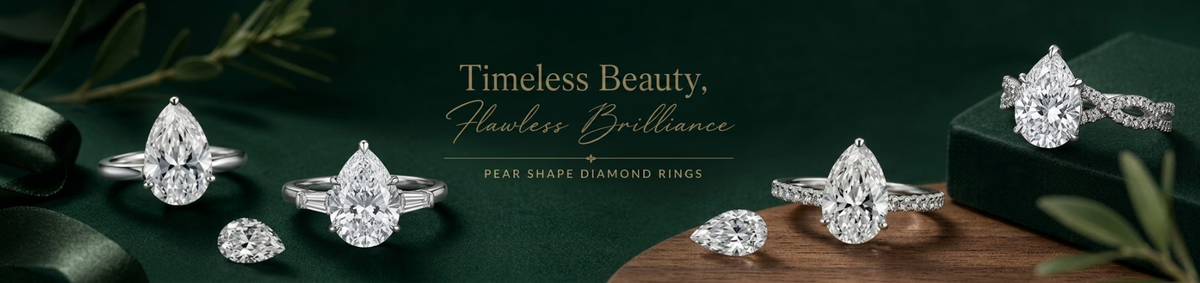
A pear shape, often called a teardrop shape, is not symmetrical from top to bottom. It has one pointed end and one fully rounded end, similar to the shape of a raindrop. An almond diamond engagement ring is symmetrical, with a point on both the top and the bottom, so it looks the same whether you view it from either direction along its length.
This difference in symmetry changes how each stone is worn and set. A pear shape almost always has to be set with the point facing a specific direction, usually toward the hand or away from it, since it only looks right one way. An almond diamond ring does not have that limitation, since both ends match, which gives more flexibility in how it can be placed in a setting, including sideways in an east-west design. In terms of look, a pear shape tends to feel like a single dramatic point balanced by a soft curve, while an almond engagement ring feels more balanced and even, since both ends mirror each other.
Curved bands follow the engagement ring's shape closely, fitting against the diamond without gaps.
Straight bands give a cleaner, simpler look that lets the engagement ring stand on its own.
Diamond eternity bands add extra shine when stacked alongside the main ring.
Plain gold bands keep things simple and let the center stone stay the focus.
Stack a curved wedding band right against the engagement ring to fill in the gap left by the pointed tips. Keep everyday jewelry simple and thin so it doesn't compete with the ring. For special occasions, matching earrings or a pendant in the same cut can round out the look nicely.
Price comes down to carat size, diamond quality, metal choice, and whether the stone is lab grown or natural. Detailed settings like halos also add to labor and material costs.
Lab grown diamond jewelry are generally priced lower than natural ones of comparable size and quality, which makes them a practical way to get a bigger stone on a set budget. Natural stones cost more per carat, particularly at higher color and clarity grades, since well-cut natural stones with strong quality are harder to come by.
A few ways to save: consider a slightly lower color or clarity grade that still looks great in person, lean toward lab grown for more size per dollar, or choose a simple solitaire setting over a halo or three-stone design.

Take it off before heavy activity like workouts, cleaning, or gardening, since the pointed tips are more vulnerable to chipping from hard bumps. Clean it at home with warm water, mild soap, and a soft brush, and steer clear of harsh chemicals that can wear down the metal or setting over time. Store it separately from other jewelry to avoid scratches, and have a jeweler check the prongs once or twice a year to make sure everything's still secure.
It suits modern brides who want something different, minimalists who prefer clean solitaire designs, and vintage lovers drawn to milgrain and filigree details. Because it's long and narrow, it also tends to flatter most finger shapes and sizes, which isn't true of every cut.
Choosing an open setting for an active lifestyle. Match the setting to how the ring will actually be worn.
Focusing only on carat size. A large stone with poor cut quality can still look dull or uneven.
Skipping certification. Always buy a certified stone, lab grown or natural, so you know exactly what you're paying for.
Getting the size wrong. This is one of the most common, and most avoidable, mistakes buyers make.
Look for a grading report from a recognized lab like IGI so you have documented proof of quality. Compare metals based on durability, cost, and skin tone. Check the seller's return policy, especially given how much you're spending. And consider whether you want to customize the setting, band width, or stone size; at Lumera Fine Jewellery, we work directly with buyers to build something that fits exactly what they're picturing.
Every jewelry piece should be as unique as the person wearing it. At Lumera Fine Jewellery, we specialize in creating custom lab-grown diamond jewelry that reflects your personal style, celebrates life's special moments, and is crafted with exceptional precision.
From choosing your favorite diamond shape and precious metal to selecting the perfect setting, our team will work with you to create a timeless design made exclusively for you.
Create Your Custom JewelryAn almond engagement ring is a solid pick if you want something that looks different without sacrificing everyday wearability. It works with nearly any metal, suits a wide range of settings, and gives you a look that isn't already on everyone else's hand. Whether you go with a simple solitaire or a detailed halo, it's a shape that balances style with practicality for a ring you'll wear for years to come.
What is an almond engagement ring?
An almond engagement ring is a ring set with a diamond cut to resemble an almond nut, with soft curves along the sides and a point at each end. It sits between an oval and a marquise cut, offering an elongated look that's still balanced through the middle.
Why are almond shape engagement rings becoming popular?
Almond shape engagement rings are becoming popular because they offer a look that's different from common round or princess cuts, while still working well for everyday wear. The elongated shape also makes the finger appear longer, which is a major reason more brides are choosing it over rounder stones.
What is an almond cut diamond ring?
An almond cut diamond ring features a diamond with pointed ends and a curved center, giving it a smooth, elongated outline. It isn't an official shape recognized by grading labs like GIA, but it's a widely used term for this rounded-marquise, pointed-oval style.
Are almond shape lab diamond rings a good choice?
Yes, almond shape lab diamond rings are a strong choice because lab grown diamonds have the same physical and chemical properties as natural diamonds, just at a lower price. This often means buyers can afford a larger or higher-quality stone within the same budget.
What is the difference between an almond ring and a traditional diamond ring?
The main difference is shape: a traditional round or princess cut diamond ring keeps the stone compact and symmetrical, while an almond ring uses an elongated shape with pointed tips. This gives an almond ring a more distinctive look and can make the diamond appear larger for the same carat weight.
Is an almond shaped engagement ring good for everyday wear?
Yes, an almond shaped engagement ring is good for everyday wear, especially when set in a protective style like a bezel or well-placed prongs. The pointed tips need slightly more care than a rounded shape, but a secure setting makes daily wear practical.
Can an almond shape engagement ring be part of a wedding ring set?
Yes, an almond shape engagement ring can be paired with a curved or contour wedding band to create a matching set. Curved bands are usually the best fit since they follow the shape of the diamond without leaving a gap.
What styles are available in almond shape rings?
Almond shape rings are available in several styles, including solitaire, hidden halo, halo, three stone, pavé band, vintage, cathedral, bezel, and east-west settings. This range makes it easy to find a design that fits a minimalist, classic, or more detailed preference.

